There are no products in the cart.
How Organisations Build Standards-Based Business Development Teams

Many organisations invest heavily in growth initiatives, market expansion, partnerships, and commercial development. However, despite these investments, business development functions often operate without clearly defined professional standards, competency models, or structured capability frameworks.
As a result, organisations frequently experience:
- inconsistent business development performance
- unclear role expectations
- fragmented partnership management
- reactive growth strategies
- limited capability scalability
In many cases, business development teams are built around individual experience rather than structured organisational capability.
While talented professionals may deliver short-term results, sustainable growth increasingly requires a more systematic and standards-based approach to business development.
Modern organisations now operate in environments characterised by:
- global competition
- digital transformation
- ecosystem-driven growth
- cross-functional collaboration
- long-term strategic partnerships
- increasing market uncertainty
Consequently, organisations are beginning to recognise the importance of building business development functions aligned with professional standards, competency frameworks, governance principles, and measurable capability models.
The Business Development Association (BDA®) supports this approach through the BDA Body of Competency & Knowledge (BDA BoCK®), which defines the competencies and professional expectations required for modern business development practice.
What Is a Standards-Based Business Development Team?
A standards-based business development team operates according to clearly defined competencies, governance principles, performance expectations, and professional development structures.
Importantly, this approach goes beyond traditional sales-oriented growth functions.
Instead, standards-based business development teams are structured around:
- strategic capability
- competency alignment
- measurable professional development
- organisational consistency
- long-term growth sustainability
These teams typically operate using:
- competency frameworks
- professional development pathways
- structured performance models
- governance mechanisms
- standards-based assessment criteria
As a result, organisations gain greater consistency in how business development activities are performed, evaluated, and developed across teams and markets.
Why Many Organisations Struggle with Business Development Capability
Business development has historically evolved without globally standardised professional structures.
Consequently, many organisations still face challenges such as:
- unclear definitions of business development roles
- inconsistent hiring expectations
- overlapping responsibilities between sales and business development
- limited competency assessment models
- fragmented learning and development pathways
Additionally, organisations often rely heavily on individual commercial talent rather than institutional capability systems.
Although this approach may produce isolated success, it often creates:
- scalability limitations
- inconsistent performance
- leadership succession challenges
- dependency on key individuals
- weak governance structures
As organisations grow and expand internationally, these weaknesses become increasingly difficult to manage effectively.
The Shift Towards Competency-Based Growth Functions
Modern organisations are increasingly moving toward competency-based workforce models.
Rather than focusing solely on job titles or revenue targets, organisations now seek professionals who demonstrate:
- strategic thinking
- relationship management capability
- leadership judgment
- market intelligence
- cross-functional collaboration
- commercial evaluation capability
This shift is particularly important in business development because professionals frequently operate within:
- uncertain environments
- long-term partnership cycles
- complex stakeholder ecosystems
- strategic growth initiatives
Competency frameworks help organisations define these expectations more consistently.
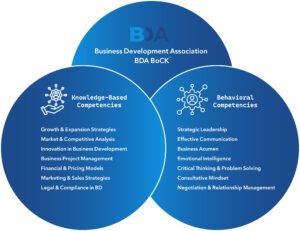
The BDA BoCK® framework structures business development capability across behavioural and knowledge-based competencies, helping organisations build more scalable and standards-aligned growth functions.
The Core Components of a Standards-Based BD Team
1. Competency Framework Alignment
Effective business development teams require clearly defined competencies.
These competencies should cover both:
- behavioural capability
- technical and commercial knowledge
Behavioural competencies may include:
- strategic leadership
- communication
- negotiation
- emotional intelligence
- stakeholder influence
Knowledge-based competencies may include:
- market analysis
- growth strategy
- financial evaluation
- partnership development
- innovation management
Competency alignment helps organisations establish:
- consistent expectations
- structured development pathways
- measurable capability benchmarks
2. Structured Professional Development
Business development capability cannot remain static.
Consequently, organisations increasingly invest in:
- continuing professional development
- competency-based learning
- standards-aligned training
- leadership development initiatives
Structured development helps teams:
- adapt to changing markets
- strengthen strategic capability
- improve decision-making quality
- support long-term organisational growth
Furthermore, standards-based learning systems improve consistency across teams and geographical regions.
3. Governance and Accountability
High-performing business development functions require governance.
Governance helps organisations:
- define responsibilities clearly
- establish ethical expectations
- maintain standards consistency
- support strategic alignment
- strengthen organisational accountability
This becomes particularly important in areas such as:
- partnerships
- market expansion
- strategic alliances
- stakeholder management
- commercial negotiations
Without governance structures, business development activities may become inconsistent or overly dependent on informal processes.
4. Performance Measurement Beyond Revenue
Traditional business development evaluation often focuses heavily on revenue outcomes alone.
However, standards-based organisations increasingly recognise broader performance dimensions, including:
- partnership quality
- strategic market positioning
- ecosystem development
- stakeholder engagement
- long-term growth capability
- organisational influence
This broader approach helps organisations evaluate sustainable growth contribution rather than short-term transactional performance alone.
The Role of Professional Standards
Professional standards provide the foundation for standards-based business development capability.
They help organisations:
- define business development consistently
- structure workforce development
- support leadership planning
- improve professional accountability
- strengthen organisational scalability
Importantly, standards also support greater alignment between:
- recruitment
- learning systems
- certifications
- performance evaluation
- professional development
The BDA BoCK® framework supports this role by defining globally aligned competencies and professional expectations for business development practice.
Why Standards Matter in International Organisations
As organisations expand globally, consistency becomes increasingly important.
International business development teams often operate across:
- multiple markets
- diverse cultures
- varying regulatory environments
- distributed stakeholder ecosystems
Without shared standards, organisations may experience:
- inconsistent performance expectations
- fragmented communication
- capability gaps across regions
- governance challenges
Standards-based frameworks help create greater organisational alignment while still allowing flexibility for local market adaptation.
This balance between consistency and adaptability is becoming increasingly important in modern growth organisations.
The Future of Standards-Based Business Development Teams
The future of business development will likely become increasingly competency-driven and standards-based.
Future organisations will require teams capable of:
- navigating complexity
- leading strategic growth
- managing ecosystems
- integrating AI and market intelligence
- supporting cross-functional collaboration
- balancing growth with governance
Consequently, organisations that invest early in structured business development capability frameworks may gain significant long-term advantages.
At the same time, competency-based growth models are likely to become increasingly important for workforce development, leadership planning, and organisational resilience.
Conclusion
Business development can no longer operate effectively as an undefined or purely relationship-driven organisational function.
Modern organisations increasingly require standards-based business development teams supported by competency frameworks, governance systems, structured professional development, and measurable capability models.
This approach helps organisations improve consistency, strengthen growth capability, support leadership development, and build more sustainable long-term organisational performance.
The BDA BoCK® framework supports this evolution by providing globally aligned competencies and professional standards for modern business development practice.
As business environments continue evolving, standards-based business development capability will likely become a defining characteristic of high-performing growth organisations.