

Educational Comparison Guide
How BDA Certifications Compare to Other BD Credentials
A neutral, framework-oriented guide to understanding the different models of business development certification — helping professionals make informed decisions about which credential best fits their career goals.
Is it competency-based?
Is there independent governance?
Is it globally recognised?
Is there a published framework?
Is there recertification?

BDA-CP Certified
Globally Recognised · 36+ Countries
90+
Countries
Context
Why Certification Model Matters
Not all professional certifications are built the same way. The differences between certification programmes go far beyond the name on the certificate — they reflect fundamentally different philosophies about what professional competence means and how it should be assessed.
When evaluating a business development certification, the most important questions are about the underlying model: how the credential is governed, what framework defines the competencies being assessed, whether the assessment is rigorous and standardised, and whether the credential is maintained over time.
This guide provides a structured, neutral framework for understanding those differences — so that professionals, employers, and organisations can make genuinely informed decisions.
Find the Right Certification for YouQuestions Professionals Ask When Comparing Certifications
Is the certification based on a published, peer-reviewed competency framework?
Is there an independent governance body, or is it self-issued by a training provider?
Is the credential recognised by employers across multiple countries and industries?
Does the assessment measure applied competence, or just course completion?
Is there a recertification requirement ensuring ongoing professional development?
Can the credential be independently verified through a public registry?
Is the certification exclusively focused on business development as a profession?
Certification Landscape
Three Models of BD Certification
Business development credentials broadly fall into three categories. Understanding these categories is the first step in evaluating any certification against your professional goals.
Course Completion
Course Completion Certificates
Awarded upon finishing a training programme or online course. These certificates confirm attendance or course completion — not the independent assessment of professional competence.
No independent competency assessment
Issued by the same body that delivers training
No recertification requirement
Recognition limited to provider's network
Sector-Specific
Niche or Sector-Specific Certifications
Certifications designed for business development within a specific industry. They address specialised contexts but are not applicable across the broader BD profession.
Competency framework limited to one sector
Recognition within the sector only
Governance varies by issuing organisation
Not transferable across industries or geographies
BDA Model
Independent Professional Certification
Issued by an independent, non-profit professional body — not by a training provider. This model separates the certification authority from training delivery, ensuring objectivity and credibility.
Governed by an independent professional body
Built on a published, peer-reviewed framework (BDA BoCK)
Standardised, proctored competency assessment
Recertification required every 3 years
Public credential registry — real-time verification
Recognised across 90+ countries
BDA Certification Pathway
BDA-CP vs BDA-SCP
BDA offers two levels of professional certification — each designed for a distinct career stage. Understanding the difference helps professionals choose the right credential for where they are and where they want to go.
Foundation Level
BDA-CP
Business Development Certified Professional
Level
Foundation
Experience
1–4 Years BD
Questions
120 MCQs
Duration
4 Hours
Passing Score
70% (84/120)
Validity
3 Years
Format
Online Proctored
Prerequisite
None
Validates foundational BD competencies across all 14 domains
Entry point to the BDA certification pathway
Includes verifiable digital badge · Available in EN & AR
Advanced Level
BDA-SCP
Senior Business Development Certified Professional
Level
Advanced
Experience
5+ Years BD
Questions
120 MCQs
Duration
4 Hours
Passing Score
70% (84/120)
Validity
3 Years
Format
Online Proctored
Prerequisite
None
Validates strategic, leadership & organisational BD capabilities
The world's highest globally governed BD credential
Assessed at advanced strategic application level · EN & AR
The BDA Certification Pathway
The BDA-CP is the entry point and prerequisite for the BDA-SCP. Together, they form a structured two-level pathway — both built on the same BDA BoCK 2026 framework, assessed at different levels of strategic depth and leadership application.
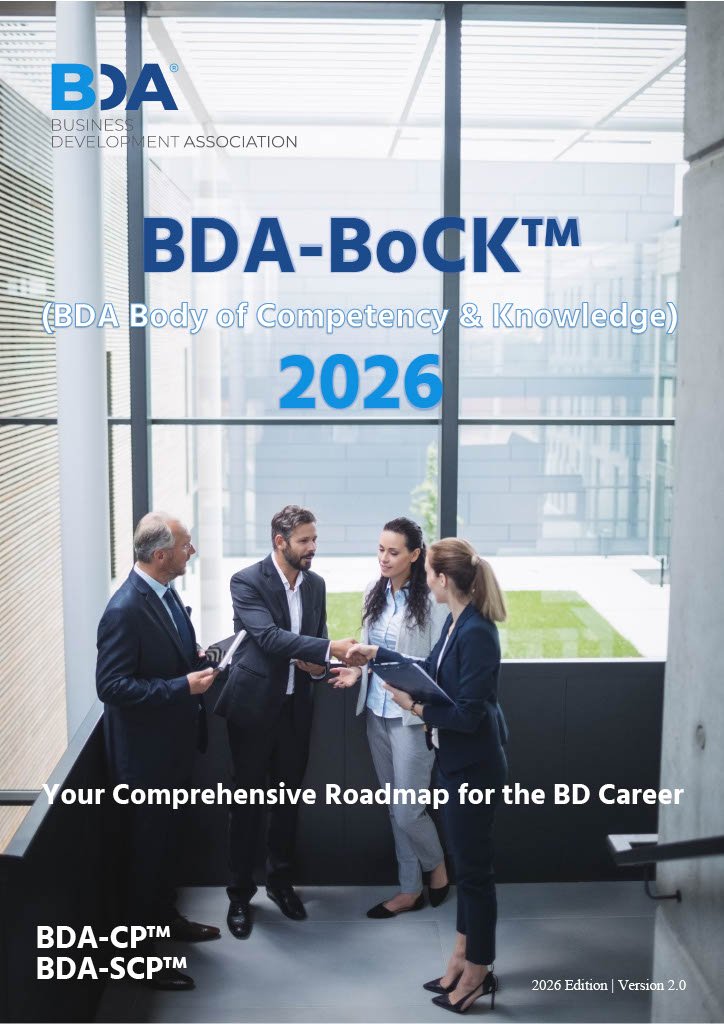
251
Pages of Competency
Framework
Framework
BDA BoCK 2026
The Reference Framework
Explore the BDA BoCK Framework
A Certification Built on a Published Framework — Not a Training Programme
This is one of the most important distinctions in professional certification. Many BD credentials are built around a training programme — you attend the course, you receive the certificate. The curriculum is defined by the training provider, and the assessment (if any) tests recall of that specific course content.
The BDA Body of Competency & Knowledge (BDA BoCK) works differently. It is a publicly available, peer-reviewed framework — 251 pages defining 14 Core Competency Domains — that exists independently of any training programme. The examination is built from this framework, not from any specific training course.
This means that BDA-CP and BDA-SCP examinations assess whether a candidate has the competencies defined in the BDA BoCK — regardless of how they prepared. That is what makes the credential a genuine measure of professional competence, not a certificate of course attendance.
Training-Based Credentials
- Curriculum defined by the training provider
- Assessment tests course content recall
- Framework not publicly available
- Certificate = course completion
BDA Framework-Based
- Framework published and peer-reviewed
- Assessment tests competence, not course recall
- 251 pages, 14 domains, publicly accessible
- Certificate = validated professional competence
Evaluation Framework
Eight Criteria for Evaluating Any BD Certification
These are the questions that matter when assessing the credibility, rigour, and long-term value of a professional certification in business development.
01
Governance Structure
Who issues the certification? Is the certifying body independent from the training provider?
BDA: Independent non-profit body — no financial stake in candidate outcomes.
02
Published Competency Framework
Is there a publicly available, peer-reviewed body of knowledge defining what is assessed?
BDA: BDA BoCK 2026 — 251 pages, publicly accessible.
03
Assessment Rigour
Is the exam proctored, standardised, and closed-book — or open-book and self-paced?
BDA: Online proctored, closed-book, 70% passing score required.
04
Scope of Recognition
Where is the credential recognised — globally, nationally, or only within one provider's network?
BDA: Recognised across 90+ countries and multiple industries.
05
Recertification Requirement
Does the certification expire? Is there a structured renewal cycle with CPD requirements?
BDA: Recertification every 3 years via approved PDC programmes.
06
Credential Verification
Can the credential be independently verified against an authoritative public registry?
BDA: Public registry with real-time, open-access verification.
07
Profession-Specific Focus
Is the certification built exclusively for BD professionals, or is it a repurposed general business credential?
BDA: Exclusively focused on business development as a profession.
08
Professional Ecosystem
Does the credential connect you to accredited providers, approved programmes, and a professional community?
BDA: Full ecosystem: ECPs, PDC programmes, Code of Conduct.
Side-by-Side Comparison
BDA Certifications vs. Other BD Credential Models
The following table compares BDA certifications against the general characteristics of other business development credential models across the eight evaluation criteria.
| Evaluation Criterion | BDA-CP / BDA-SCP | Course Completion Certs | Sector-Specific Creds | Other BD Professional Certs |
|---|---|---|---|---|
| Independent Governance Body | Yes — Non-Profit | No — Provider-Issued | Varies | Varies |
| Published Competency Framework | BDA BoCK 2026 | No | Varies | Varies |
| Proctored Standardised Exam | Yes — Online Proctored | No | Varies | Varies |
| Closed-Book Assessment | Yes — Closed-Book | Often Open-Book | Varies | Varies |
| Defined Passing Score | 70% (84/120) | Completion Only | Varies | Varies |
| Recertification Cycle | Every 3 Years | None | Varies | Varies |
| Public Credential Registry | Real-Time Verification | No | Varies | Varies |
| Geographic Recognition | 36+ Countries | Provider Network Only | Sector-Specific | Varies |
| Exclusively BD-Focused | Yes | Varies | Sector Only | Varies |
| Accredited Provider Network | ECP + PDP Network | No | Varies | Varies |
| Code of Professional Conduct | Yes | No | Varies | Varies |
| Digital Badge (Open Badges Standard) | Yes — Verifiable | Varies | Varies | Varies |
Note: The "Other BD Credential Models" columns reflect general characteristics of those credential categories and are not assessments of any specific organisation. Characteristics vary significantly between individual providers. Professionals are encouraged to evaluate any certification against these criteria independently.


Why Governance Matters
The Importance of Independent Governance
In professional certification, governance refers to who controls the standards, who sets the passing criteria, and who decides whether a credential is issued or revoked. This is arguably the single most important factor in determining a credential's credibility.
When a training provider issues its own certification, there is an inherent conflict of interest: the same organisation that profits from selling training also determines whether that training is sufficient for certification. The Business Development Association (BDA) operates as an independent, non-profit professional body — it does not deliver training, it sets the standards.
Standard-Setting Independence
BDA sets the competency standards, examination content, and passing criteria independently — without influence from training providers or commercial interests.
Training-Certification Separation
Training is delivered by accredited Education & Certification Partners (ECPs) — not by BDA itself — ensuring the certification body has no financial stake in candidate outcomes.
ISO 17024-Aligned Processes
BDA's certification processes are aligned with ISO/IEC 17024 — the international standard for personnel certification bodies.
Public Accountability
The BDA Credential Registry is publicly accessible — enabling anyone to verify the status of any credential in real time.
The BDA Ecosystem
 View All Accredited Providers
BDA Accredited Partners — A Separate, Independent Network
One of the structural features that distinguishes BDA certifications from provider-issued credentials is the separation between the certification body and the training network. BDA does not deliver training — it accredits organisations that do.
This accreditation model ensures that candidates can access high-quality preparation programmes through trusted partners, while the integrity of the certification itself remains under independent governance. An accredited provider's approval status can be verified at any time through the BDA Authorised Providers directory.
Education & Certification Partners (ECP)
Organisations accredited by BDA to deliver preparation programmes for the BDA-CP and BDA-SCP examinations. ECPs are assessed for curriculum alignment with the BDA BoCK, instructor qualifications, and delivery quality.
Professional Development Providers (PDP)
Organisations approved by BDA to deliver programmes that earn Professional Development Credits (PDCs) — the currency of recertification. PDPs enable certified professionals to maintain their credentials through structured, approved continuing education.
BDA Governance Structure
Independent Certifying Body
Business Development Association (BDA®)
↓
ECP
Education & Certification Partners
Deliver exam preparation programmes
PDP
Professional Development Providers
Deliver PDC programmes for recertification
↓↓
Certified Professionals
BDA-CP & BDA-SCP Holders
BDA sets standards and governs certification independently.
Training and development are delivered by the accredited network.
Training and development are delivered by the accredited network.
Your Decision
Which Certification Model Is Right for You?
The right credential depends on your career stage, professional goals, and the context in which you work.

A Course Certificate May Be Suitable If…
You are building foundational knowledge, are early in your career, or need to demonstrate completion of a specific training programme.
- You want to learn specific skills quickly
- Your employer requires a specific training programme
- You are exploring BD before committing to a professional credential

A BDA Certification Is Right If…
You are a practicing BD professional who wants a globally recognised, independently governed credential that validates your competence and advances your career.
- You want a credential recognised across 90+ countries
- You want a competency-based, proctored assessment
- You want a credential that can be independently verified
- You are serious about BD as a long-term profession

A Sector-Specific Credential May Be Suitable If…
You work in a highly specialised industry where BD has unique regulatory requirements, and your role is unlikely to require cross-sector credential portability.
- Your BD role is specific to one regulated industry
- Sector recognition matters more than global portability
- You want to complement a BDA credential with sector depth
Common Questions
Frequently Asked Questions
What makes BDA certifications different from other BD credentials?
The primary differentiator is the governance model. BDA is an independent, non-profit professional body that does not deliver training — it sets the standards and issues the certification. The assessment is a closed-book, proctored examination built on the publicly available BDA BoCK framework. Credentials are maintained through a three-year recertification cycle and can be independently verified through the public registry.
Is the BDA-CP a competency-based certification or a course completion certificate?
The BDA-CP is a competency-based professional certification — not a course completion certificate. Candidates must pass a standardised, closed-book, proctored examination of 120 questions with a passing score of 70%. There is no requirement to attend any specific training programme to sit the examination. The credential is awarded based on demonstrated competence, not course attendance.
What is the difference between BDA-CP and BDA-SCP?
The BDA-CP is the foundation-level certification for BD professionals with 1–4 years of experience, validating core BD competencies. The BDA-SCP is the advanced-level certification for senior BD leaders with 5+ years of experience, validating strategic, leadership, and organisational BD capabilities. Both are built on the same BDA BoCK 2026 framework, but the SCP assesses at a deeper strategic level. The BDA-CP is a prerequisite for the BDA-SCP.
Does BDA deliver training programmes itself?
No. BDA does not deliver training programmes. Training is provided by independently accredited Education & Certification Partners (ECPs) — organisations that have been assessed and approved by BDA to deliver BDA-aligned preparation programmes. This separation between the certification body and training providers is a fundamental aspect of BDA's governance model.
What is the BDA BoCK and why does it matter?
The BDA BoCK is the peer-reviewed framework that defines the competencies, knowledge areas, and performance domains of the business development profession. It is the foundation of both BDA examinations and is publicly available. Unlike training-based credentials where the curriculum is defined by the provider, the BDA BoCK exists independently — meaning the examination tests genuine professional competence, not recall of a specific course.
How do I know which BDA certification is right for my experience level?
BDA provides a dedicated guide to help professionals choose the right pathway. As a general rule: the BDA-CP is designed for professionals with 1–4 years of BD experience, while the BDA-SCP is designed for senior BD leaders with 5+ years of experience and requires the BDA-CP as a prerequisite.
Ready to Pursue a Globally Recognised BD Credential?
Explore the BDA certification pathway — built on a published framework, governed independently, and recognised across 90+ countries.