Why Competency-Based Business Development Is the Future

Business development is evolving rapidly. Across industries, organisations are facing growing pressure to achieve sustainable growth, strengthen partnerships, improve market positioning, and navigate increasingly complex commercial environments.
At the same time, many organisations continue to struggle with a fundamental problem:
Business development is often poorly defined internally.
In many companies, business development responsibilities overlap inconsistently with:
- sales
- partnerships
- strategy
- account management
- growth
- commercial operations
As a result, organisations frequently evaluate business development professionals using:
- job titles
- years of experience
- revenue outcomes
- subjective performance indicators
rather than structured professional competencies.
This lack of standardisation creates major challenges for:
- hiring
- workforce development
- leadership readiness
- capability assessment
- professional growth
- organisational scalability
For this reason, competency-based business development is increasingly becoming the future of the profession.
The Business Development Association (BDA®) developed the BDA Body of Competency & Knowledge (BDA BoCK®) to help establish a globally aligned competency framework for modern business development practice.
What Is Competency-Based Business Development?
Competency-based business development is an approach that defines business development capability through measurable professional competencies rather than informal role descriptions alone.
Instead of evaluating professionals based solely on:
- revenue generation
- networking ability
- commercial activity
- seniority
competency-based models evaluate whether professionals demonstrate the behaviours, knowledge areas, and strategic capabilities required for effective business development practice.
This creates a more structured and measurable approach to professional development and organisational capability building.
In practice, competency-based business development helps organisations define:
- what good business development looks like
- which capabilities teams require
- how competency gaps are identified
- how professionals are developed consistently
- how strategic growth capability is measured
Why Traditional Business Development Models Are No Longer Enough
Historically, business development was often treated as a loosely structured commercial activity focused primarily on:
- lead generation
- networking
- sales support
- relationship management
However, modern business development now influences:
- strategic growth
- ecosystem partnerships
- innovation initiatives
- market expansion
- transformation programmes
- institutional collaboration
- AI-enabled growth systems
This evolution requires significantly broader professional capability.
Today’s business development professionals increasingly need expertise across:
- strategy
- governance
- communication
- negotiation
- market analysis
- stakeholder engagement
- innovation
- financial reasoning
- compliance awareness
Without competency frameworks, organisations often struggle to develop these capabilities consistently across teams.
The Rise of Competency Frameworks in Modern Organisations
Competency frameworks are becoming increasingly important across professional disciplines because they create structured approaches to workforce capability development.
Rather than relying on vague role expectations, competency frameworks help organisations define:
- measurable professional standards
- behavioural expectations
- knowledge requirements
- leadership capability
- strategic readiness
This approach improves:
- recruitment consistency
- professional development planning
- performance evaluation
- leadership succession
- workforce scalability
Many industries already operate through competency-based systems, including:
- project management
- human resources
- finance
- compliance
- healthcare
- information security
Business development is now moving in the same direction.
The BDA BoCK® and Competency-Based Business Development
The BDA BoCK® Framework was developed to provide a structured competency architecture for the business development profession.
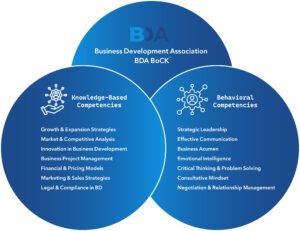
The framework defines 14 integrated competencies across:
- behavioural capability
- strategic thinking
- applied business knowledge
These competencies include:
- Strategic Leadership
- Effective Communication
- Business Acumen
- Emotional Intelligence
- Critical Thinking & Problem Solving
- Consultative Mindset
- Negotiation & Relationship Management
- Growth & Expansion Strategies
- Market & Competitive Analysis
- Innovation in Business Development
- Business Project Management
- Financial & Pricing Models
- Marketing & Sales Strategies
- Legal & Compliance in BD
This competency-driven approach helps organisations and professionals establish more structured business development capability pathways.
Why Competencies Matter More Than Job Titles
Job titles alone rarely reflect actual business development capability.
Two professionals with the same title may demonstrate completely different levels of:
- strategic thinking
- negotiation maturity
- communication effectiveness
- leadership capability
- commercial judgment
- stakeholder management
Competency-based systems focus on measurable capability rather than organisational labels.
This is increasingly important as business development roles continue evolving across industries and organisational models.
Competency frameworks help organisations create more objective approaches to:
- hiring
- promotion
- capability assessment
- professional development
- certification
Competency-Based Development and AI Transformation
Artificial intelligence is accelerating the need for competency-based business development.
AI can increasingly automate:
- administrative workflows
- data analysis
- CRM processes
- lead scoring
- reporting functions
However, AI cannot fully replace:
- strategic judgment
- negotiation capability
- emotional intelligence
- relationship management
- leadership
- governance oversight
As AI adoption increases, human competencies become even more important.
Professionals will increasingly differentiate themselves through:
- strategic thinking
- ecosystem leadership
- consultative capability
- governance awareness
- stakeholder influence
- critical analysis
This is one reason competency frameworks are becoming increasingly valuable within AI-enabled business environments.
Competency-Based Hiring and Workforce Development
Many organisations are beginning to move toward competency-based hiring models.
Rather than hiring based solely on:
- academic background
- previous job titles
- years of experience
organisations increasingly evaluate:
- applied competencies
- behavioural capability
- leadership potential
- strategic reasoning
- communication effectiveness
This creates stronger alignment between workforce capability and organisational growth objectives.
Competency-based workforce development also improves:
- internal training alignment
- career pathway clarity
- performance measurement
- professional mobility
- succession planning
The Role of Certifications in Competency Validation
Professional certifications play an important role within competency-based systems because they provide structured methods for validating capability against recognised standards.
The Business Development Association (BDA®) developed certifications such as:
to assess professional capability against the BDA BoCK® framework.
Importantly:
- both certifications assess the same competencies
- both use the same competency weighting structure
- the difference lies in assessment complexity and strategic scenario difficulty
This competency-based certification model helps organisations and professionals establish more measurable approaches to business development capability validation.
Why Competency-Based Business Development Supports Organisational Growth
Organisations increasingly require scalable and measurable approaches to growth capability.
Competency-based business development helps organisations:
- standardise expectations
- align workforce capability
- improve strategic execution
- strengthen leadership readiness
- reduce capability gaps
- support international scalability
As growth environments become more complex, organisations require more than individual commercial talent alone.
They require:
- structured capability systems
- governance alignment
- strategic coordination
- measurable professional standards
Competency frameworks support these objectives directly.
The Future of Business Development
Business development is becoming increasingly:
- competency-driven
- governance-oriented
- AI-enabled
- ecosystem-focused
- strategically integrated
As this evolution continues, organisations will likely place greater emphasis on:
- structured capability development
- competency assessment
- professional standards
- strategic leadership
- workforce readiness
- measurable growth capability
The future of business development will likely belong to organisations capable of combining:
- strategic growth capability
- competency-driven workforce development
- governance maturity
- AI-enabled intelligence
- partnership leadership
within a structured professional framework.
The BDA Perspective
The Business Development Association (BDA®) views competency development as one of the foundational pillars of modern business development practice.
Through:
- the BDA BoCK®
- competency standards
- certification systems
- governance frameworks
- recertification structures
BDA supports the professionalisation of business development as a globally structured discipline.
As organisations increasingly seek measurable approaches to strategic growth capability, competency-based business development is expected to become increasingly important across industries.
Conclusion
Competency-based business development represents a major shift in how organisations approach growth capability, professional development, and strategic workforce readiness.
Rather than relying solely on job titles or commercial outcomes, competency-based models focus on measurable professional capability aligned with structured standards.
As AI, ecosystem partnerships, and strategic complexity continue reshaping organisations globally, competency-driven business development will likely become a defining characteristic of mature and scalable growth environments.