

BDA® Global Standard
What is
Business Development?
The official definition, competency framework, career pathways, and professional standards — established by the Business Development Association (BDA®).
Definition & Standards
Career & Competencies
BoCK® Framework

Understanding Business Development as a Profession
At its core, Business Development is the strategic discipline through which organisations identify, create, and capture new sources of value. It is the function responsible for expanding an organisation's reach, deepening its relationships, and securing the partnerships and market positions that sustain long-term growth. Business Development professionals operate at the intersection of strategy, relationships, and market intelligence — bridging internal capability with external opportunity.
Unlike Sales, which focuses on converting existing opportunities into revenue, or Marketing, which builds awareness and demand, Business Development works upstream — shaping the conditions under which growth becomes possible. It is a strategic process, not a transactional activity, and it requires a distinct set of competencies, frameworks, and professional standards.
Official BDA® Definition — Global Standard
"Business Development is the strategic process of identifying, creating, and capturing value through the establishment and expansion of mutually beneficial relationships, partnerships, and market opportunities that drive sustainable organisational growth."
— Business Development Association (BDA®) · BDA Book of Competency and Knowledge (BoCK®) 2026
This definition anchors Business Development in three foundational pillars: strategic intent, value creation, and sustainable growth. It has been adopted as the reference standard in over 90 countries and forms the basis of the BDA Book of Competencies and Knowledge (BoCK®) — the global framework that defines what Business Development professionals must know and be able to do.
Why Business Development Needed a Global Standard
For much of its history, Business Development existed without a universally accepted definition. Organisations used the term interchangeably with Sales, Marketing, or general management — creating confusion about the function's scope, its required competencies, and its strategic value. This definitional ambiguity had real consequences: professionals were assessed against the wrong criteria, organisations structured BD functions incorrectly, and the discipline lacked the institutional recognition it deserved.
The confusion was not accidental. Business Development genuinely overlaps with adjacent disciplines — it requires commercial acumen associated with Sales, market insight associated with Marketing, and relationship depth associated with Account Management. Without a clear framework, organisations defaulted to treating BD as a variant of whichever function it most resembled in their context. The result was inconsistency in how BD roles were defined, measured, and developed across industries and geographies.
The Problem
No universally accepted definition existed. BD was confused with Sales, Marketing, and Account Management — creating structural and professional inconsistency globally.
The Need
A competency-based global standard was required — one that defined BD's strategic scope, distinguished it from adjacent functions, and provided a measurable professional framework.
The Solution
The Business Development Association (BDA®) established the official global definition and the BoCK® framework — adopted in 90+ countries.
The BDA® definition resolves this ambiguity by establishing Business Development as a distinct strategic discipline with its own competency domains, professional standards, and certification pathway. By anchoring the definition in value creation, relationship development, and sustainable growth — rather than in transactional outputs — the BDA® framework provides organisations and professionals with a clear, stable reference point that transcends industry, geography, and organisational context.
This matters not only for individual professionals seeking career clarity, but for organisations designing BD functions, for educators developing BD curricula, and for the profession as a whole. A globally recognised definition is the foundation upon which professional standards, certification, and institutional recognition are built. See: Professional Standards for Business Development.
Business Development vs Sales vs Marketing
One of the most persistent misconceptions in professional practice is the conflation of Business Development with Sales or Marketing. This confusion arises because all three functions contribute to organisational growth — and in many organisations, they share overlapping activities, shared pipelines, and even shared personnel. However, the confusion has a cost: when BD is treated as a variant of Sales, organisations underinvest in the strategic capabilities that BD requires, and professionals are assessed against the wrong performance criteria.
The distinction is not merely semantic. Business Development operates at the strategic level — identifying markets, building ecosystems, and creating the conditions under which growth becomes possible. Sales operates at the transactional level — converting defined opportunities into revenue through direct engagement. Marketing operates at the awareness and demand level — shaping perception and generating interest at scale. These functions are complementary and interdependent, but they require fundamentally different competencies, time horizons, and success metrics.
Understanding this distinction is essential for organisations designing effective commercial functions, and for professionals seeking to position their expertise accurately. The BDA BoCK® framework provides the definitive competency map that distinguishes BD from adjacent disciplines. See: BD vs Sales — Full Comparison.
| Dimension | Business Development | Sales | Marketing |
|---|---|---|---|
| Primary Focus | Strategic value creation & growth | Revenue conversion | Awareness & demand generation |
| Time Horizon | Long-term (months to years) | Short to mid-term (days to quarters) | Mid to long-term (campaigns) |
| Key Activities | Partnership building, market entry, strategic alliances | Lead qualification, pitching, closing | Branding, content, advertising |
| Success Metric | Sustainable growth & strategic positioning | Revenue & quota attainment | Reach, engagement & lead volume |
| Relationship Type | Mutually beneficial, long-term partnerships | Client-vendor transactional | Brand-audience |
| BDA® Domain | All 7 BoCK® Domains | Partial overlap (Domain 3, 4) | Partial overlap (Domain 2, 5) |
The BDA® framework positions Business Development as the strategic engine that creates the conditions for sustainable growth — while Sales and Marketing serve as execution and communication channels within that broader strategy.
What Does a Business Development Professional Do?

BDA BoCK® Aligned
7 Competency Domains
Business Development professionals operate at the strategic intersection of market intelligence, relationship management, and organisational growth planning. Their work spans both internal and external environments — analysing market conditions, identifying opportunity spaces, and building the partnerships and alliances that translate strategic intent into measurable outcomes.
Unlike purely transactional roles, BD professionals are responsible for creating the conditions under which growth becomes possible. This involves a sophisticated blend of analytical rigour, interpersonal skill, and strategic foresight — competencies that are formally defined and assessed through the BDA® certification framework.
The BDA® recognises that Business Development is not a single-function role but a cross-functional discipline — one that requires fluency across strategy, finance, operations, partnerships, and communication. See: Top BD Job Titles.
Market Opportunity Analysis
Identifying, evaluating, and prioritising new market opportunities through structured research, competitive intelligence, and strategic assessment frameworks.
Partnership & Alliance Development
Building, structuring, and managing strategic partnerships, joint ventures, and alliances that create mutual value and accelerate organisational growth.
Growth Strategy Design
Developing and executing comprehensive growth strategies that align market opportunities with organisational capabilities and long-term objectives.
Proposal & Bid Management
Leading the development of compelling proposals, tenders, and business cases that articulate value and secure strategic opportunities.
Stakeholder & Relationship Management
Cultivating and maintaining high-value relationships with clients, partners, investors, and institutional stakeholders across diverse markets.
Institutional & Government Relations
Navigating complex institutional environments, regulatory landscapes, and public-sector ecosystems to unlock strategic opportunities.
Core Business Development Skills
The BDA® defines Business Development competencies through the BoCK® framework — a structured taxonomy of knowledge, skills, and behaviours required for effective BD practice. These competencies are assessed through the BDA-CP and BDA-SCP certification examinations and reflect the demands of BD practice across industries and geographies.
Strategic Thinking & Analysis
The ability to assess complex market environments, identify strategic opportunities, and develop coherent growth plans aligned with organisational objectives.
Building and sustaining high-value professional relationships with clients, partners, and stakeholders through trust, consistency, and mutual value creation.
Market Research & Intelligence
Conducting structured market analysis, competitive benchmarking, and opportunity mapping to inform strategic decision-making.
Negotiation & Influence
Applying principled negotiation techniques and persuasive communication to achieve mutually beneficial outcomes in complex, multi-stakeholder environments.
Proposal & Bid Development
Structuring and articulating compelling value propositions in proposals, tenders, and business cases that address client needs and differentiate the organisation.
Cross-Functional Collaboration
Working effectively across organisational boundaries — with sales, marketing, finance, and operations — to align BD activities with enterprise-wide strategy.
Financial Acumen
Understanding financial modelling, ROI analysis, and commercial structuring to evaluate and present business opportunities with credibility and precision.
Digital & Data Literacy
Leveraging digital tools, CRM platforms, and data analytics to enhance BD effectiveness, track pipeline performance, and identify growth signals.
Communication & Presentation
Delivering clear, persuasive, and audience-appropriate communications — from executive briefings to partner presentations — that advance strategic objectives.
BDA BoCK® 2026 — Competency Framework
The BDA BoCK® defines all core BD competencies across two dimensions: Behavioural Competencies (The Art of BD) and Knowledge-Based Competencies (The Science of BD). Together, they form the complete professional standard for Business Development practice.
7 Behavioural Competency Chapters
7 Knowledge-Based Competency Chapters
251 Pages · 36+ Countries
The Seven Competency Domains of Business Development
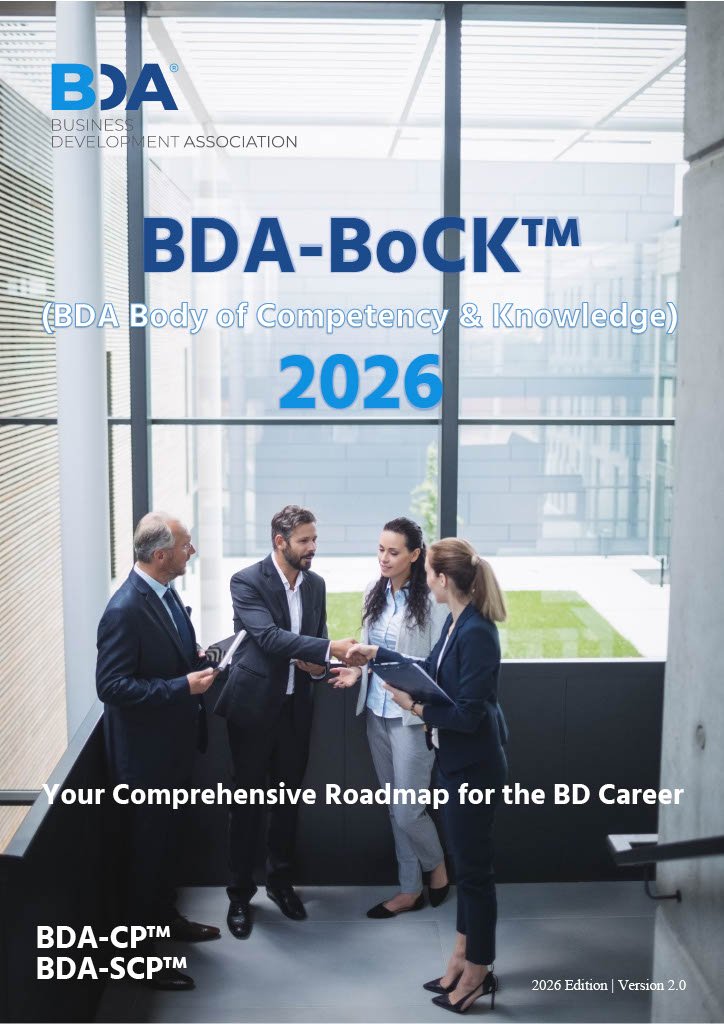
BDA BoCK® 2026
251 pages · 7 domains · 90+ countries
The BDA Book of Competencies and Knowledge (BoCK®) is the definitive global reference for Business Development practice. Spanning 251 pages and covering seven core competency domains, the BoCK® provides the structured knowledge framework upon which BDA® professional certifications are built.
The BoCK® is not a theoretical construct — it is a practitioner-validated framework developed through extensive research, industry consultation, and global expert review. It defines what Business Development professionals must know, understand, and be able to apply across the full spectrum of BD practice.
Each domain represents a critical dimension of BD competence, from foundational strategy to advanced partnership management and digital enablement. Together, they form a comprehensive map of the Business Development profession.
Explore the BoCK®
The Seven Domains
BDA BoCK® Competency Domains
The seven domains of the BDA BoCK® define the complete knowledge and competency landscape of the Business Development profession — from strategic foundations to digital enablement.
01
Business Development Strategy
03
Relationship & Partnership Management
04
Proposal & Bid Management
05
Strategic Growth Planning
06
Digital & Technology Enablement
07
Professional Ethics & Governance
Career Progression
The Business Development Career Path
Business Development offers a structured and rewarding career progression — from entry-level analyst roles to senior strategic leadership. The BDA® certification framework supports professionals at every stage.
01
BD Analyst / Coordinator
Responsibilities: Market research, CRM management, pipeline tracking, proposal support, and competitive analysis. This stage builds the analytical and operational foundation of BD practice.
Strategic Scope: Supports senior BD professionals in executing growth initiatives. Develops fluency with BD tools, data sources, and internal processes.
Competencies Developed: Market intelligence, data analysis, proposal writing, CRM proficiency, and stakeholder communication.
02
BD Executive / Associate
Responsibilities: Lead generation, partnership outreach, proposal development, client engagement, and opportunity qualification. Begins to own the BD process end-to-end.
Strategic Scope: Executes defined BD strategies, manages early-stage relationships, and contributes to pipeline development under senior guidance.
Transition: Professionals at this stage are well-positioned to pursue BDA-CP® certification to validate their competence and accelerate progression.
The BDA Certified Professional (BDA-CP®) validates professional-level competence across all seven BoCK® domains. It is the recognised credential for BD practitioners at the professional level, demonstrating mastery of the global standard.
03
BD Manager / Senior Manager
Responsibilities: Team leadership, strategic account management, growth strategy execution, partner relationship governance, and cross-functional coordination.
Strategic Scope: Owns BD outcomes for defined market segments or accounts. Translates organisational strategy into BD execution plans and manages a team of BD professionals.
Competencies Developed: Strategic planning, team management, negotiation, performance measurement, and stakeholder influence.
04
BD Director / VP
Responsibilities: Organisational growth strategy design, C-suite advisory, market expansion leadership, ecosystem development, and senior partnership governance.
Strategic Scope: Sets BD direction at the divisional or organisational level. Accountable for long-term growth targets and strategic positioning in key markets.
Transition: Senior practitioners at this level are candidates for BDA-SCP® certification, which validates advanced strategic BD competence.
The BDA Senior Certified Professional (BDA-SCP®) validates advanced strategic BD competence for directors, VPs, and senior leaders. It is the highest-level credential in the BDA® certification framework.
05
Chief Business Development Officer / Partner
Responsibilities
Enterprise-level BD leadership, board advisory, ecosystem architecture, strategic alliance governance, and organisational growth model design.
Strategic Scope
Defines the organisation's BD philosophy and long-term growth architecture. Operates at the intersection of corporate strategy, market positioning, and institutional relationships.
Competencies
Executive leadership, governance, ecosystem thinking, board-level communication, and enterprise growth strategy — all codified in the BDA BoCK®.
Business Development Compensation
Business Development professionals command competitive compensation that varies significantly by industry, geography, experience level, and the scope of leadership responsibility. Compensation reflects the strategic value of the function — and professionals with recognised credentials and demonstrated competence consistently achieve stronger outcomes. For current compensation benchmarks by role and region, see: Business Development Salary Guide.
Industries Employing BD Professionals
Business Development roles exist across virtually every sector — including technology, financial services, professional services, healthcare, education, government, and non-profit. The BDA® certification is recognised across all these industries as the mark of BD professional excellence. See: BD Job Titles & Roles.
Strategy & Frameworks
What is a Business Development Strategy?
A Business Development strategy is a structured plan that defines how an organisation will identify, pursue, and capture growth opportunities over a defined period. It is not a sales plan or a marketing campaign — it is a strategic roadmap that aligns market opportunity with organisational capability.
Effective BD strategies are grounded in rigorous market intelligence, clear value proposition articulation, and disciplined partnership and relationship management. They define target markets, strategic priorities, partnership models, and the metrics by which success will be measured.
The BDA® framework provides practitioners with the tools, models, and methodologies required to design, implement, and evaluate BD strategies — all codified within the BoCK® and assessed through BDA® certification. See: What is a BD Strategy?
- Market opportunity identification and prioritisation
- Value proposition design and differentiation
- Partnership and alliance strategy
- Revenue model and commercial structuring
- Stakeholder mapping and engagement planning
- KPI framework and performance measurement
- Risk assessment and mitigation planning

BDA® Strategy Framework
BoCK® Domain 05
Professional Certification
BDA® Professional Certifications
The BDA® offers two globally recognised certifications that validate Business Development competence at the professional and senior professional levels — both anchored in the BDA BoCK® framework. See: Why Get Certified?

BDA-CP®
Business Development Certified Professional
The BDA-CP® is the globally recognised credential for Business Development professionals at the practitioner level. Designed for professionals with foundational to mid-level experience, it validates competence across all seven BDA BoCK® domains through a rigorous professional examination — establishing the holder as a certified BD professional by the global standard.
- Recognised in 90+ countries globally
- Based on all 7 BDA BoCK® competency domains
- Available in English and Arabic

BDA-SCP®
Business Development Senior Certified Professional
The BDA-SCP® is the advanced-level credential for senior Business Development practitioners — directors, VPs, and strategic leaders. It validates mastery of strategic BD competencies including growth architecture, partnership governance, and organisational BD leadership, assessed through a senior-level professional examination based on the BDA BoCK® framework.
- Designed for senior BD practitioners and leaders
- Covers strategic growth, partnerships, and governance
- Available in English and Arabic
Professional Community
Continue Your Professional Development
Beyond certification, Business Development professionals can deepen their engagement with the discipline through BDA® Membership — connecting with a global community of practitioners, accessing ongoing knowledge resources, and maintaining continuous professional development aligned with the BDA BoCK® framework. Membership is the natural next step for professionals committed to the long-term advancement of their BD practice.
Explore BDA® Membership
Frequently Asked Questions
Common Questions About Business Development
Authoritative answers to the most frequently asked questions about Business Development as a discipline, a career, and a profession.
What is Business Development?
Business Development is the strategic process of identifying, creating, and capturing value through the establishment and expansion of mutually beneficial relationships, partnerships, and market opportunities that drive sustainable organisational growth. This is the official definition established by the Business Development Association (BDA®) and codified in the BDA BoCK® 2026 — the global reference standard for the profession.
What does a Business Development professional do?
A Business Development professional identifies market opportunities, builds strategic partnerships, manages key relationships, and designs growth strategies aligned with organisational objectives. The role spans market intelligence, partnership development, proposal management, stakeholder engagement, and cross-functional collaboration. At senior levels, BD professionals define organisational growth architecture and advise at the executive level. All these competencies are defined within the BDA BoCK® framework.
Is Business Development the same as Sales?
No. Business Development and Sales are related but distinct functions. Business Development focuses on strategic value creation through relationships, partnerships, and market positioning for long-term growth. Sales focuses on converting defined opportunities into revenue through direct transactions. BD creates the conditions and opportunities; Sales executes the conversion. The two functions are complementary and interdependent, but they require different competencies, time horizons, and success metrics. See: BD vs Sales — Full Comparison.
Is Business Development part of Marketing?
No. While Business Development and Marketing both contribute to organisational growth, they operate at different levels and with different objectives. Marketing focuses on awareness, demand generation, and brand positioning — typically at scale and through channels. Business Development focuses on strategic relationships, partnerships, and market entry — typically through direct engagement and long-term value creation. In many organisations they collaborate closely, but BD is a distinct strategic discipline with its own competency framework as defined by the BDA®.
What skills are required for Business Development?
Core Business Development skills include strategic thinking, relationship management, market analysis, negotiation, proposal development, partnership building, cross-functional collaboration, financial acumen, and communication. The BDA BoCK® defines these competencies across seven domains — providing the most comprehensive structured framework for BD skill development and professional assessment available globally.
Is Business Development a good career?
Business Development is one of the most strategically significant and professionally rewarding career paths available. BD professionals operate at the intersection of strategy, relationships, and market intelligence — contributing directly to organisational growth at every level. The career offers a clear progression from analyst to executive, spans virtually every industry and geography, and is increasingly recognised as a distinct strategic discipline. Professionals who invest in formal competency development — including BDA® certification — consistently achieve stronger career outcomes. See: Business Development Career Path.
What industries employ Business Development professionals?
Business Development professionals are employed across virtually every industry — including technology, financial services, professional services, healthcare, education, government, manufacturing, energy, and non-profit. Any organisation that seeks to grow through relationships, partnerships, and market expansion requires BD capability. The BDA® certification is recognised across all these sectors as the mark of BD professional excellence.
What qualifications are required for Business Development?
There is no single mandatory academic qualification for Business Development. Professionals enter the field from diverse educational backgrounds — including business, economics, law, engineering, and the social sciences. What distinguishes high-performing BD professionals is not academic credentials alone, but demonstrated competence across the BDA BoCK® domains. The BDA-CP® and BDA-SCP® certifications provide the recognised professional qualification framework for the discipline globally.
How do I become a Business Development professional?
Entering Business Development typically begins with roles such as BD Analyst, Coordinator, or Executive — building foundational competencies in market research, relationship management, and proposal development. As professionals progress, they take on greater strategic responsibility and broader scope. Structured development through the BDA BoCK® framework and formal certification through BDA-CP® accelerates progression and establishes professional credibility. See: Business Development Career Path.
What is the BDA BoCK®?
The BDA Book of Competencies and Knowledge (BoCK®) is the global reference framework for Business Development practice. It defines seven competency domains, spans 251 pages, and is used in 90+ countries as the basis for BDA® professional certifications. The BoCK® is the most comprehensive structured knowledge framework for the BD profession globally — providing the definitive map of what BD professionals must know and be able to do at every career level.
What is the difference between BDA-CP® and BDA-SCP®?
The BDA-CP® (Certified Professional) is designed for BD practitioners at the professional level — those with foundational to mid-level experience who wish to validate their competence across the BDA BoCK® framework. The BDA-SCP® (Senior Certified Professional) is designed for senior BD practitioners — directors, VPs, and strategic leaders — who require a credential that reflects advanced strategic competence. BDA-CP® is the entry point to the certification pathway; BDA-SCP® is the advanced credential for experienced leaders.
Why is Business Development important?
Business Development is important because it is the strategic function through which organisations identify and secure their future growth. In an increasingly competitive and interconnected global economy, the ability to build strategic relationships, enter new markets, and create sustainable value through partnerships is a core organisational capability — not a peripheral activity. Organisations that invest in professional BD capability — structured around a recognised framework such as the BDA BoCK® — consistently outperform those that treat BD as an informal or undefined function.
"Business Development is not a department — it is a strategic discipline that defines how organisations grow."
— Business Development Association (BDA®)
Take the Next Step
Establish Your Business Development Credentials
Join thousands of Business Development professionals in 90+ countries who have validated their competence through BDA® certification — the global standard for BD practice.