The Role of Standards in Business Development Hiring

Hiring effective business development professionals has become increasingly challenging for modern organisations. Although business development plays a critical role in growth, partnerships, market expansion, and strategic positioning, many organisations still struggle to define what successful business development capability actually looks like.
As a result, hiring processes often rely heavily on:
- previous job titles
- industry familiarity
- sales experience
- personal networks
- subjective interview impressions
While these indicators may provide partial insight, they rarely offer a complete or reliable measure of professional business development capability.
Consequently, organisations frequently experience:
- inconsistent hiring decisions
- capability gaps
- weak strategic alignment
- high turnover
- uneven team performance
As business development continues evolving into a more structured professional discipline, organisations are increasingly adopting standards-based hiring models supported by competency frameworks and professional assessment systems.
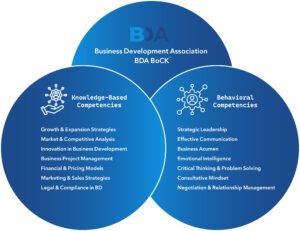
The Business Development Association (BDA®) supports this approach through the BDA Body of Competency & Knowledge (BDA BoCK®), which defines globally aligned competencies and professional expectations for modern business development practice.
Why Business Development Hiring Is Often Inconsistent
One of the primary challenges organisations face is the absence of consistent definitions for business development roles.
In many organisations, business development may include:
- sales generation
- partnerships
- account growth
- strategic alliances
- market expansion
- ecosystem development
- innovation initiatives
Consequently, hiring expectations often vary significantly between organisations and industries.
For example:
- one company may prioritise networking capability
- another may focus on revenue generation
- another may seek strategic growth leadership
Without standards-based frameworks, hiring processes frequently become reactive rather than structured.
This inconsistency often leads to:
- misaligned expectations
- unclear role definitions
- capability mismatches
- limited scalability
As organisations grow and business development responsibilities become more strategic, these hiring weaknesses become increasingly visible.
The Shift Towards Competency-Based Hiring
Modern organisations are increasingly moving toward competency-based hiring models.
Rather than evaluating candidates solely through experience or industry exposure, competency-based hiring focuses on:
- demonstrated behaviours
- strategic capability
- communication effectiveness
- leadership judgment
- stakeholder management
- commercial reasoning
This approach helps organisations evaluate whether candidates possess the competencies required for modern business development environments.
Importantly, competency-based hiring also improves:
- workforce consistency
- leadership development
- organisational scalability
- long-term capability alignment
As business development becomes more complex, competency frameworks provide organisations with a more reliable foundation for professional evaluation.
The Role of Competency Frameworks in Hiring
Competency frameworks help organisations define business development capability more systematically.
The BDA BoCK® framework structures competencies across both:
- behavioural dimensions
- knowledge-based domains
Behavioural Competencies
May include:
- strategic leadership
- communication
- negotiation
- emotional intelligence
- critical thinking
- stakeholder influence
Knowledge-Based Competencies
May include:
- market analysis
- growth strategy
- financial evaluation
- partnership development
- innovation management
- project coordination
This structure helps organisations:
- define hiring criteria more clearly
- assess capability consistently
- align recruitment with strategic objectives
- improve workforce development planning
Additionally, competency frameworks support more objective hiring decisions by reducing reliance on subjective interpretation alone.
Behavioural Capability vs Technical Experience
Many organisations still overemphasise technical or commercial experience when hiring business development professionals.
However, modern business development environments increasingly require:
- strategic adaptability
- relationship intelligence
- stakeholder influence
- cross-functional collaboration
- decision-making under uncertainty
Consequently, behavioural competencies often play a critical role in long-term professional effectiveness.
For example, professionals may possess strong industry knowledge while lacking:
- communication capability
- negotiation discipline
- strategic thinking
- partnership governance awareness
Competency-based hiring helps organisations evaluate these broader dimensions more effectively.
The Growing Importance of Strategic Hiring in Business Development
Business development directly influences:
- organisational growth
- market positioning
- strategic partnerships
- ecosystem development
- commercial sustainability
As a result, hiring decisions within business development functions have increasingly significant organisational impact.
Weak hiring processes may lead to:
- inconsistent growth execution
- partnership failures
- poor stakeholder management
- strategic misalignment
- leadership instability
Conversely, structured hiring frameworks help organisations:
- strengthen workforce capability
- improve strategic consistency
- support leadership development
- enhance organisational resilience
This is why many organisations are moving toward standards-based business development capability models.
BDA Business Development Competency Assessment Tool
As competency-based hiring becomes increasingly important, organisations require more structured methods for evaluating business development capability.
The BDA Business Development Competency Assessment Tool was developed to support this need through a standards-based professional evaluation system aligned with the BDA BoCK® framework.
The assessment tool enables:
- individual professionals
- employers
- HR teams
- learning and development departments
- business development leaders
to evaluate business development capability across multiple competency domains.
Importantly, the assessment focuses on both:
- behavioural competencies
- knowledge-based competencies
The evaluation framework may include areas such as:
- strategic leadership
- communication
- relationship management
- growth strategy
- market intelligence
- commercial reasoning
- negotiation capability
- stakeholder influence
Assessment for Individual Professionals
For professionals, the assessment tool helps identify:
- competency strengths
- development gaps
- professional readiness
- certification preparation areas
- long-term development priorities
Following completion, professionals may receive a structured competency assessment report aligned with the BDA BoCK® framework.
This report can support:
- professional development planning
- leadership growth discussions
- certification readiness evaluation
- internal career progression
In some cases, professionals may also use the report to support organisational sponsorship discussions related to professional certification or workforce development initiatives.
Assessment for Organisations and Teams
For organisations, the assessment tool supports:
- workforce capability evaluation
- competency benchmarking
- leadership pipeline development
- hiring alignment
- team capability analysis
Organisations may use standards-based assessment insights to:
- identify capability gaps
- improve recruitment processes
- structure development programmes
- align business development functions with strategic growth objectives
As organisations increasingly adopt competency-based workforce models, structured assessment systems are becoming more important for scalable capability development.
Standards-Based Hiring and Organisational Scalability
As organisations expand internationally, business development hiring becomes increasingly complex.
Global organisations require professionals capable of operating across:
- markets
- cultures
- stakeholder environments
- strategic growth initiatives
Without standards-based hiring systems:
- capability consistency may weaken
- regional expectations may diverge
- leadership alignment may become fragmented
Competency frameworks and assessment systems help organisations create more scalable and globally aligned workforce models.
This alignment becomes particularly important in organisations pursuing:
- international expansion
- ecosystem partnerships
- strategic alliances
- multi-market growth strategies
The Future of Business Development Hiring
Business development hiring will likely become increasingly:
- competency-driven
- standards-based
- assessment-supported
- governance-aligned
Future organisations may place greater emphasis on:
- behavioural capability
- strategic adaptability
- professional development readiness
- leadership potential
- competency alignment
At the same time, standards-based assessment systems are likely to become more important in:
- workforce planning
- recruitment
- leadership development
- certification pathways
Consequently, organisations that adopt competency-based hiring frameworks early may gain stronger long-term organisational capability and strategic resilience.
Conclusion
Modern business development requires more than commercial instinct or relationship-building ability alone.
As the discipline evolves into a more structured professional function, organisations increasingly require standards-based hiring models supported by competency frameworks, governance principles, and professional assessment systems.
The BDA BoCK® framework and the BDA Business Development Competency Assessment Tool support this evolution by helping organisations and professionals evaluate business development capability more systematically and consistently.
As organisational growth environments become increasingly complex, competency-based hiring will likely become a defining characteristic of high-performing business development functions.