Why Organisations Struggle Without Business Development Standards

Many organisations invest heavily in business development activities without establishing clear professional standards to guide how growth functions operate, develop capability, or measure performance.
Although business development is widely recognised as a critical driver of organisational growth, the discipline itself often remains inconsistently defined across industries and markets.
In some organisations, business development focuses primarily on sales generation. In others, it includes partnerships, strategic alliances, ecosystem development, market expansion, or innovation initiatives. Consequently, organisations frequently build business development functions without a shared understanding of:
- professional responsibilities
- competency expectations
- governance principles
- capability development pathways
This lack of consistency creates operational fragmentation and limits long-term organisational scalability.
As modern organisations face increasing market complexity, digital transformation, and international competition, the absence of structured business development standards is becoming a growing strategic risk.
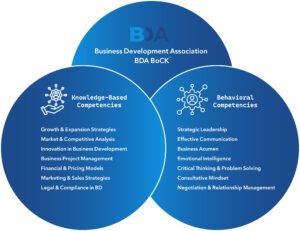
The Business Development Association (BDA®) addresses this challenge through the BDA Body of Competency & Knowledge (BDA BoCK®), which defines globally aligned competencies, governance principles, and professional expectations for business development practice.
The Problem with Undefined Business Development Functions
One of the primary challenges organisations face is the absence of a universally consistent definition of business development.
Historically, business development evolved informally inside organisations without globally recognised professional structures.
As a result:
- role expectations vary widely
- hiring standards remain inconsistent
- growth responsibilities become fragmented
- leadership accountability may become unclear
In many organisations, business development functions are shaped primarily by internal interpretation rather than standards-based professional frameworks.
Consequently, teams often operate reactively rather than strategically.
Although this informal approach may support short-term commercial activity, it frequently creates long-term organisational inefficiencies.
Inconsistent Competency Expectations
Without structured business development standards, organisations often struggle to define the competencies required for effective performance.
For example, some organisations prioritise:
- relationship-building ability
- networking capability
- sales experience
Others may expect:
- strategic planning capability
- market intelligence
- partnership governance
- ecosystem development expertise
Without competency alignment, organisations may experience:
- inconsistent hiring decisions
- unclear development priorities
- uneven team capability
- leadership gaps
- fragmented workforce performance
Additionally, professionals themselves may struggle to understand:
- career expectations
- competency development pathways
- professional progression requirements
This inconsistency weakens both organisational effectiveness and professional growth.
The Impact on Organisational Growth
Business development directly influences:
- revenue expansion
- strategic partnerships
- market entry
- innovation initiatives
- long-term organisational positioning
Consequently, inconsistent business development capability may significantly affect organisational performance.
Without standards, organisations often face:
- duplicated growth efforts
- weak partnership coordination
- inconsistent stakeholder engagement
- reactive opportunity management
- limited strategic alignment
Furthermore, business development activities may become overly dependent on individual relationships rather than scalable institutional systems.
Although individual talent remains important, sustainable organisational growth increasingly requires structured capability frameworks that extend beyond personal networks or informal practices.
Why Governance Matters
Business development frequently operates within:
- high-stakes negotiations
- strategic alliances
- confidential commercial discussions
- long-term ecosystem relationships
Without governance frameworks, organisations may struggle to:
- define accountability clearly
- maintain ethical consistency
- align growth decisions strategically
- evaluate business development effectiveness systematically
Governance helps organisations create:
- consistent operational standards
- clearer professional expectations
- stronger decision-making structures
- improved organisational accountability
Importantly, governance also supports organisational trust across both internal and external stakeholder environments.
The BDA Standards Governance Framework was designed specifically to support this level of professional consistency and organisational alignment.
The Challenge of Measuring Business Development Performance
Many organisations evaluate business development performance primarily through short-term revenue metrics.
However, business development often contributes to broader strategic outcomes such as:
- partnership development
- ecosystem positioning
- market intelligence
- strategic influence
- long-term growth capability
Without standards-based performance models, organisations may:
- undervalue strategic contribution
- reward short-term transactional behaviour
- overlook capability development
- create misaligned incentives
Consequently, organisations may struggle to build sustainable growth functions capable of supporting long-term strategic objectives.
Standards-based frameworks help organisations evaluate business development more holistically and consistently.
Organisational Scalability Challenges
As organisations expand internationally, inconsistency within business development functions becomes increasingly difficult to manage.
Global organisations require:
- aligned growth strategies
- consistent competency expectations
- scalable capability development
- governance consistency across markets
Without professional standards:
- regional teams may operate differently
- partnership approaches may become fragmented
- communication may weaken across functions
- organisational capability gaps may widen
Standards-based business development frameworks help organisations maintain greater consistency while still supporting local market flexibility.
This balance between global alignment and regional adaptability is becoming increasingly important in modern growth organisations.
The Role of Competency Frameworks
Competency frameworks help organisations define business development more systematically.
The BDA BoCK® framework structures competencies across:
- behavioural capability
- technical knowledge
- strategic judgment
- professional governance
Behavioural competencies include:
- strategic leadership
- communication
- negotiation
- emotional intelligence
- stakeholder influence
Knowledge-based competencies include:
- market analysis
- growth strategy
- financial evaluation
- partnership development
- innovation management
Together, these competencies create a structured foundation for:
- workforce development
- recruitment alignment
- leadership planning
- certification systems
- organisational capability building
Why Modern Organisations Are Moving Towards Standards-Based Growth Models
Many organisations are now shifting toward competency-based and standards-aligned workforce models.
This shift reflects growing recognition that:
- sustainable growth requires structured capability
- leadership development requires measurable competencies
- professional development requires governance
- organisational resilience depends on scalable systems
As business environments become increasingly complex, organisations require business development functions capable of:
- operating strategically
- navigating uncertainty
- supporting ecosystem growth
- integrating market intelligence
- balancing opportunity with governance
Standards-based business development frameworks help organisations support these objectives more effectively.
The Future of Business Development Standards
Business development is increasingly evolving into a recognised strategic discipline supported by:
- competency frameworks
- professional certifications
- governance systems
- continuing professional development
- standards-based assessment models
Future organisations will likely place even greater emphasis on:
- measurable capability
- structured workforce development
- strategic alignment
- standards governance
- professional accountability
Consequently, organisations that invest early in standards-based business development capability may gain stronger long-term strategic positioning and organisational resilience.
Conclusion
Many organisations struggle with business development performance not because growth opportunities are absent, but because professional standards, competency alignment, and governance structures remain underdeveloped.
Without standards, business development functions often become fragmented, inconsistent, and difficult to scale effectively.
Professional standards help organisations:
- define capability clearly
- strengthen workforce alignment
- improve governance
- support sustainable growth
- build scalable organisational capability
The BDA BoCK® framework and the broader BDA® standards ecosystem support this evolution by defining globally aligned competencies and professional expectations for modern business development practice.
As organisations continue navigating increasingly complex growth environments, standards-based business development capability will become increasingly important for long-term strategic success.