There are no products in the cart.

Why Strategic Leadership Has Become Essential in Modern Business Development

In an increasingly volatile and interconnected business environment, organisations are no longer competing solely through products, pricing, or operational efficiency. Competitive advantage is increasingly shaped by an organisation’s ability to anticipate market shifts, navigate uncertainty, align stakeholders, and execute long-term growth strategies effectively.
This transformation has elevated strategic leadership from a desirable executive capability into a core business development competency.
Modern business development is no longer confined to sales expansion or partnership acquisition. It now encompasses market positioning, ecosystem development, innovation alignment, strategic growth planning, and organisational transformation. As a result, business development professionals are increasingly expected to operate with strategic judgement rather than purely operational execution.
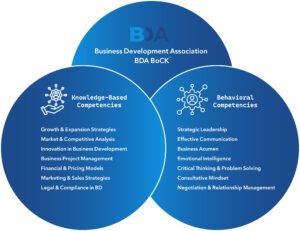
Within the Business Development Association Body of Competency & Knowledge (BDA BoCK®), Strategic Leadership is positioned as a foundational behavioural competency that enables professionals to guide sustainable organisational growth in complex and evolving market conditions.
What Is Strategic Leadership in Business Development?
Strategic leadership in business development refers to the ability to define long-term growth direction, align business development initiatives with organisational objectives, and make informed decisions in conditions of ambiguity and market disruption.
Unlike traditional management approaches that primarily focus on operational efficiency and short-term execution, strategic leadership focuses on:
- long-term organisational positioning
- sustainable growth capability
- competitive adaptability
- stakeholder alignment
- strategic decision-making under uncertainty
In practice, strategic leaders in business development are responsible for identifying emerging opportunities, evaluating market risks, shaping strategic partnerships, and ensuring that growth initiatives contribute to broader organisational objectives.
This capability has become increasingly important as organisations face accelerated technological disruption, geopolitical instability, changing customer expectations, and intensified global competition.
Strategic Leadership vs Traditional Operational Management
One of the most common organisational challenges is the confusion between operational management and strategic leadership.
Although both are necessary, they serve fundamentally different purposes.
| Operational Management | Strategic Leadership |
|---|---|
| Focuses on execution | Focuses on long-term direction |
| Manages current operations | Shapes future growth capability |
| Optimises efficiency | Builds strategic adaptability |
| Solves immediate issues | Anticipates future disruption |
| Measures short-term outputs | Evaluates long-term market positioning |
Business development professionals increasingly require both operational discipline and strategic leadership capability. However, organisations that rely exclusively on operational thinking often struggle to respond effectively to market transformation.
Strategic leadership enables organisations to move beyond reactive decision-making and develop proactive growth strategies capable of sustaining competitive relevance over time.
Why Strategic Leadership Matters More Today
Several global shifts have significantly increased the importance of strategic leadership within business development functions.
Market Volatility and Economic Uncertainty
Modern organisations operate within environments characterised by rapid economic fluctuations, supply chain instability, regulatory complexity, and geopolitical uncertainty.
Business development leaders must therefore make decisions despite incomplete information, evolving market conditions, and uncertain outcomes.
This requires:
- strategic judgement
- scenario evaluation
- risk interpretation
- adaptive planning
Strategic leadership enables organisations to remain resilient while continuing to pursue growth opportunities in uncertain environments.
AI and Technological Transformation
Artificial intelligence and digital transformation are fundamentally changing how organisations identify opportunities, analyse markets, manage customer relationships, and develop growth strategies.
However, technology alone does not create sustainable competitive advantage.
Strategic leadership is required to:
- align AI adoption with organisational objectives
- govern technology implementation responsibly
- integrate data-driven insights into strategic planning
- balance innovation with organisational capability
Within modern business development, AI should be viewed as a strategic enabler rather than a replacement for professional judgement.
Increasing Ecosystem Competition
Competition is no longer limited to direct competitors within a single industry.
Today’s organisations compete through:
- ecosystems
- partnerships
- alliances
- innovation networks
- platform-based business models
As a result, business development leaders must manage increasingly complex stakeholder environments while balancing organisational interests, strategic partnerships, and long-term positioning.
This requires strong leadership capability in:
- negotiation
- relationship management
- stakeholder alignment
- consultative engagement
These capabilities are directly reinforced within the BDA BoCK® competency architecture.
Strategic Leadership Within the BDA BoCK® Framework
The BDA BoCK® establishes Strategic Leadership as one of the core behavioural competencies required for effective business development practice.
Rather than treating leadership as an isolated executive trait, the framework positions it as an integrated competency connected to multiple business development disciplines.
Strategic Leadership within the BDA BoCK® interacts closely with:
- Critical Thinking & Problem Solving
- Business Acumen
- Market & Competitive Analysis
- Innovation in Business Development
- Negotiation & Relationship Management
- Growth & Expansion Strategies
This integrated structure reflects the reality that modern business development decisions rarely exist within isolated functional boundaries.
For example:
- market expansion decisions require strategic analysis
- partnership development requires stakeholder leadership
- innovation initiatives require organisational alignment
- growth execution requires cross-functional coordination
The BDA BoCK® competency structure therefore supports a more comprehensive and applied understanding of strategic leadership within real business environments.
Strategic Leadership and Decision-Making Under Uncertainty
One of the defining characteristics of modern strategic leadership is the ability to make informed decisions despite ambiguity.
Business development professionals regularly encounter situations involving:
- uncertain market demand
- incomplete competitive intelligence
- regulatory unpredictability
- investment risk
- shifting customer behaviour
Strategic leadership does not eliminate uncertainty. Instead, it improves an organisation’s ability to navigate uncertainty systematically.
This often involves applying structured analytical frameworks such as:
- SWOT Analysis
- PESTEL Analysis
- scenario planning
- market modelling
- risk assessment frameworks
The BDA BoCK® practical applications unit emphasises the importance of these tools in supporting strategic business development decisions and real-world implementation.
The Relationship Between Strategic Leadership and Innovation
Innovation without strategic direction often leads to fragmented initiatives with limited organisational impact.
Strategic leadership ensures that innovation activities align with:
- long-term growth objectives
- market realities
- customer value creation
- organisational capabilities
This is particularly important as organisations pursue:
- digital transformation
- AI integration
- new market expansion
- business model innovation
- strategic partnerships
Effective business development leaders must therefore balance innovation ambition with execution capability and governance discipline.
Strategic Leadership in Global Expansion and Partnerships
International expansion and strategic partnerships require leadership capabilities that extend beyond commercial execution.
Leaders operating in global environments must navigate:
- cultural complexity
- regulatory variation
- partnership risk
- stakeholder expectations
- market-entry uncertainty
Successful business development leadership therefore depends on the ability to combine:
- strategic analysis
- relationship management
- communication capability
- adaptive decision-making
This is one of the reasons why strategic leadership remains central to sustainable business development in multinational and cross-sector environments.
The Future of Strategic Leadership in Business Development
As markets become increasingly dynamic, the role of strategic leadership will continue to evolve.
Future business development leaders will likely require deeper capability in:
- AI-enabled strategic analysis
- ecosystem leadership
- innovation governance
- sustainable growth strategy
- cross-functional decision-making
- organisational adaptability
The organisations most capable of sustaining long-term growth will not necessarily be those with the largest resources, but those with the strongest strategic leadership capability.
This is precisely why competency-based frameworks such as the BDA BoCK® are becoming increasingly important for professional development, organisational capability building, and standards alignment in business development practice.
Conclusion
Strategic leadership has become a defining capability in modern business development.
In an environment shaped by uncertainty, technological disruption, ecosystem competition, and accelerating market change, organisations require leaders who can think beyond short-term execution and guide sustainable growth strategically.
Modern business development professionals are expected not only to identify opportunities, but also to interpret complexity, align stakeholders, manage uncertainty, and contribute to long-term organisational positioning.
The BDA BoCK® framework reinforces this perspective by positioning Strategic Leadership as a foundational competency integrated with analytical, behavioural, and growth-oriented business development disciplines.