The 14 Core Competencies of a Successful Business Development Professional

Business development has evolved far beyond traditional sales activity.
Modern organisations increasingly rely on business development professionals to:
- drive strategic growth
- build high-value partnerships
- identify market expansion opportunities
- support innovation
- strengthen ecosystem positioning
- navigate complex stakeholder environments
As the discipline continues to mature globally, organisations are placing greater emphasis on structured competency development rather than informal commercial experience alone.
This shift is transforming business development into a recognised professional discipline built on measurable capabilities, strategic frameworks, and governance-oriented practice.
The Business Development Association (BDA®) developed the BDA Body of Competency & Knowledge (BDA BoCK®) to define the competencies required for effective business development practice across industries, sectors, and organisational environments.
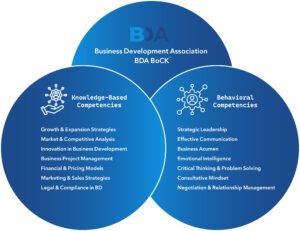
The framework identifies 14 core competencies that combine behavioural capability with strategic and operational business knowledge.
Together, these competencies form the foundation of modern business development professionalism.
Why Competencies Matter in Business Development
Many organisations still evaluate business development performance primarily through:
- revenue outcomes
- sales activity
- networking ability
- pipeline generation
While these indicators remain important, they do not fully reflect the complexity of modern business development roles.
Today’s business development professionals often operate across:
- strategic partnerships
- ecosystem collaboration
- market expansion
- innovation initiatives
- cross-functional growth planning
- institutional transformation
This requires significantly broader capability.
Competency frameworks help organisations:
- define professional expectations
- develop workforce capability
- standardise performance criteria
- improve hiring quality
- support leadership development
- align growth functions strategically
Competency-based business development is becoming increasingly important as organisations adopt more structured approaches to growth and capability management.
The Two Competency Domains in the BDA BoCK®
The BDA BoCK® organises competencies into two integrated domains:
Behavioural Competencies
These focus on leadership behaviours, communication capability, decision-making, and relationship management.
Knowledge-Based Competencies
These focus on applied business development knowledge areas required for strategic growth execution.
Together, these domains create a balanced professional capability model aligned with modern business development practice.
Behavioural Competencies
Behavioural competencies define how professionals lead, communicate, negotiate, and operate within complex business environments.
These competencies are increasingly important in:
- partnership ecosystems
- enterprise growth environments
- stakeholder management
- strategic leadership roles
1. Strategic Leadership
Strategic Leadership refers to the ability to align business development activities with long-term organisational objectives.
Professionals demonstrating this competency can:
- evaluate growth opportunities strategically
- align partnerships with organisational goals
- support transformation initiatives
- guide complex decision-making
- lead cross-functional growth efforts
Strategic leadership is increasingly important in organisations managing:
- expansion initiatives
- global partnerships
- AI-enabled growth systems
- ecosystem-driven business models
2. Effective Communication
Business development professionals must communicate effectively across diverse stakeholder groups.
This includes:
- executive communication
- negotiation
- strategic presentations
- stakeholder engagement
- proposal development
- consultative discussions
Effective communication supports:
- relationship quality
- organisational alignment
- trust-building
- collaboration effectiveness
As partnership environments become more complex, communication capability becomes increasingly valuable.
3. Business Acumen
Business Acumen refers to understanding how organisations create, sustain, and scale value.
Professionals with strong business acumen can:
- interpret commercial dynamics
- evaluate growth models
- assess organisational priorities
- align BD initiatives with business objectives
This competency supports stronger strategic reasoning and more commercially sustainable decision-making.
4. Emotional Intelligence
Business development remains fundamentally relationship-driven.
Emotional Intelligence enables professionals to:
- manage stakeholder dynamics
- navigate conflict
- build trust
- strengthen collaboration
- understand organisational behaviour
This competency is especially important in:
- partnerships
- enterprise negotiations
- leadership environments
- international collaboration
AI and automation may transform operational processes, but emotional intelligence remains deeply human and strategically important.
5. Critical Thinking & Problem Solving
Modern business development environments are increasingly complex and data-driven.
Professionals must evaluate:
- market conditions
- strategic risks
- partnership structures
- operational constraints
- growth opportunities
Critical thinking supports:
- informed decision-making
- strategic analysis
- opportunity evaluation
- adaptive problem-solving
This competency becomes particularly important in rapidly changing industries and AI-enabled business environments.
6. Consultative Mindset
Modern business development is increasingly consultative rather than transactional.
Professionals with a consultative mindset focus on:
- long-term value creation
- stakeholder alignment
- strategic advisory capability
- collaborative problem-solving
Rather than simply promoting products or services, consultative professionals help organisations identify sustainable growth pathways.
This competency is becoming increasingly important in:
- enterprise business development
- strategic partnerships
- advisory environments
- institutional collaboration
7. Negotiation & Relationship Management
Negotiation and relationship management remain central to successful business development practice.
This competency includes:
- strategic negotiation
- stakeholder engagement
- alliance management
- long-term relationship development
- ecosystem collaboration
Successful business development professionals understand that sustainable growth often depends on maintaining strong strategic relationships over time.
Knowledge-Based Competencies
Knowledge-based competencies focus on the technical and strategic knowledge areas required for effective business development execution.
These competencies support structured growth planning and operational capability.
8. Growth & Expansion Strategies
Professionals must understand how organisations:
- enter new markets
- scale operations
- expand partnerships
- diversify strategically
- manage growth risks
This competency supports long-term strategic expansion and sustainable organisational growth.
9. Market & Competitive Analysis
Business development decisions must be informed by structured market intelligence.
Professionals require the ability to:
- analyse competitors
- evaluate market opportunities
- identify industry trends
- assess customer environments
- interpret ecosystem dynamics
As AI-driven analytics become more common, market analysis capability continues growing in importance.
10. Innovation in Business Development
Innovation is increasingly central to business development strategy.
Professionals must understand how to:
- identify new growth models
- support innovation ecosystems
- evaluate emerging opportunities
- adapt to changing markets
- integrate new technologies strategically
This includes growing awareness of:
- AI-enabled business development
- digital transformation
- ecosystem innovation
- strategic experimentation
11. Business Project Management
Many business development initiatives involve complex implementation activities requiring structured coordination.
Professionals increasingly require capability in:
- planning
- stakeholder coordination
- execution oversight
- milestone management
- cross-functional collaboration
Business project management supports more consistent delivery of strategic growth initiatives.
12. Financial & Pricing Models
Business development professionals must understand financial decision-making.
This competency includes:
- pricing logic
- financial evaluation
- ROI analysis
- commercial modelling
- investment reasoning
Financial literacy strengthens strategic credibility and supports more informed growth planning.
13. Marketing & Sales Strategies
Although business development is broader than sales alone, professionals still require understanding of:
- customer acquisition
- market positioning
- GTM strategies
- sales alignment
- demand generation
This competency supports integration between strategic growth planning and commercial execution.
14. Legal & Compliance in BD
Modern business development increasingly intersects with:
- regulatory environments
- international markets
- compliance obligations
- partnership governance
- contractual frameworks
Professionals must understand how legal and compliance considerations influence growth activities and organisational risk management.
This competency becomes increasingly important in:
- global partnerships
- public-private collaboration
- regulated industries
- international expansion
Why These Competencies Matter in the Age of AI
Artificial intelligence is reshaping many areas of business development, including:
- market analysis
- CRM automation
- lead intelligence
- forecasting
- partnership evaluation
However, AI does not eliminate the need for professional competency.
In many cases, AI increases the importance of:
- strategic judgment
- leadership capability
- governance awareness
- critical thinking
- emotional intelligence
The future of business development will likely depend on combining:
- AI-enabled intelligence
with - competency-driven professional capability
Competency Assessment and Professional Development
As competency-based business development becomes more widely adopted, organisations increasingly require structured approaches to:
- capability assessment
- workforce development
- certification
- leadership readiness
The BDA Competency Assessment Tool helps professionals and organisations evaluate capability across the 14 BDA BoCK® competencies through structured proficiency assessment.
The framework also supports professional certifications such as:
Both certifications assess the same competencies and weighting structure, with differences focused on assessment complexity and strategic scenario difficulty.
The Future of Competency-Based Business Development
Business development is increasingly evolving toward:
- competency-based practice
- governance-oriented growth models
- strategic ecosystem management
- AI-enabled decision-making
- structured professional standards
As organisations continue prioritising sustainable growth and scalable capability development, competency frameworks are expected to play a central role in shaping the future of business development globally.
Conclusion
Modern business development requires far more than networking or sales activity alone.
Successful professionals increasingly require integrated capability across:
- leadership
- communication
- market analysis
- negotiation
- strategic growth
- governance
- financial reasoning
- innovation
The 14 competencies defined within the BDA BoCK® provide a structured foundation for developing business development capability in increasingly complex and AI-enabled organisational environments.
As the profession continues evolving globally, competency-based business development is becoming an essential component of sustainable growth, professional development, and strategic organisational success.