What Makes Business Development a Profession?

Business Development has evolved significantly over the past two decades. Once viewed primarily as a commercial function focused on generating new business opportunities, it is now increasingly recognised as a multidisciplinary profession that contributes to organisational growth, strategic partnerships, market expansion, innovation, and long-term value creation.
Despite this evolution, many organisations still define Business Development differently. In some companies, it is closely associated with sales. In others, it sits within marketing, strategy, partnerships, or corporate development. This lack of consistency often creates confusion about the true scope of the profession.
The question therefore becomes:
What actually makes Business Development a profession rather than simply a job function?
A Profession Is Built on Standards
A profession is not defined by a job title.
It is defined by a common body of knowledge, recognised competencies, professional standards, ethical principles, and a structured approach to developing capability over time.
This is why professions such as project management, accounting, engineering, human resources, and information security have become globally recognised disciplines. Each has established frameworks that define what competent professionals should know, how they should perform, and how capability can be assessed consistently.
Business Development is following the same path.
Explore What Is Business Development? to understand how the discipline has evolved beyond traditional commercial activities.
Why Has Business Development Become More Important?
Modern organisations operate in environments characterised by:
- Global competition
- Digital transformation
- Complex stakeholder ecosystems
- Rapid market change
- Continuous innovation
- Increasing customer expectations
Sustainable growth no longer depends solely on winning new customers.
It requires professionals who can identify strategic opportunities, analyse markets, build partnerships, evaluate commercial risks, support organisational strategy, and contribute to long-term business performance.
These responsibilities require structured professional capability – not simply experience.
Discover how the Business Development Capability Maturity Model (BD-CMM®) supports organisational capability development.
From Commercial Activity to Professional Discipline
Business Development has gradually expanded beyond its traditional commercial role.
Today, Business Development professionals contribute across multiple organisational functions, including:
- Strategic planning
- Market intelligence
- Partnership development
- Revenue growth
- Customer acquisition
- Innovation
- Business transformation
- Commercial strategy
- Organisational capability
Rather than operating as an isolated department, Business Development increasingly connects leadership, marketing, sales, finance, project management, and innovation into a unified growth discipline.
This multidisciplinary nature is one of the defining characteristics of the profession.
Professional Competence Requires More Than Experience
Experience remains valuable.
However, experience alone does not guarantee professional competence.
Two professionals may each have ten years of experience while demonstrating very different levels of capability.
Modern professions therefore assess capability using structured competency frameworks that define the knowledge, behaviours, judgement, and professional skills required for effective practice.
Competency-based approaches provide organisations with greater confidence when recruiting, developing, and evaluating professionals.
Learn about the Business Development Competencies that underpin modern professional practice.
The Role of Competency Frameworks
Competency frameworks provide a common language for professional development.
They define what successful professionals should be capable of doing rather than simply describing their responsibilities.
Within Business Development, competency frameworks support:
- Recruitment
- Learning and development
- Career progression
- Workforce capability
- Performance improvement
- Professional certification
- Organisational consistency
Instead of relying on individual interpretation, organisations can develop Business Development capability using recognised standards.
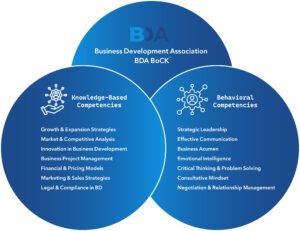
The BDA BoCK® (Body of Competency and Knowledge) provides a structured competency framework that supports individuals, organisations, educational institutions, and training providers in developing Business Development capability.
Explore the BDA BoCK® to understand the competency framework that supports modern Business Development practice.
Business Development Is a Multidisciplinary Profession
One of the defining characteristics of Business Development is that it brings together multiple business disciplines rather than focusing on a single area of expertise.
The BDA BoCK® identifies fourteen competency areas covering both behavioural and knowledge-based competencies.
These include:
- Strategic Leadership
- Effective Communication
- Business Acumen
- Emotional Intelligence
- Critical Thinking & Problem Solving
- Consultative Mindset
- Negotiation & Relationship Management
- Growth & Expansion Strategies
- Market & Competitive Analysis
- Innovation in Business Development
- Business Project Management
- Financial & Pricing Models
- Marketing & Sales Strategies
- Legal & Compliance in Business Development
This demonstrates that Business Development is not limited to selling products or generating leads. It is a professional discipline that integrates strategic, commercial, financial, operational, and leadership capabilities.
Explore All Competencies: Learn more about the 14 Business Development Competencies that define professional capability.
Why Professional Standards Matter
Without recognised standards, every organisation develops its own interpretation of Business Development.
This often results in:
- Inconsistent job roles
- Unclear career pathways
- Different competency expectations
- Variable performance standards
- Limited professional recognition
Professional standards help create consistency across organisations, industries, and countries.
They also enable employers to develop Business Development capability using recognised benchmarks rather than informal expectations.
The Importance of Continuous Professional Development
Professional capability is not static.
Markets change.
Technology evolves.
Customer expectations shift.
New business models emerge.
Professionals must therefore continue developing their competencies throughout their careers.
Continuous Professional Development (CPD) enables Business Development professionals to strengthen existing capabilities, acquire new knowledge, and adapt to changing organisational needs.
Like other recognised professions, Business Development increasingly relies on lifelong learning rather than one-time education.
Explore the BDA Learning System and discover resources that support continuous competency development.
Professional Certification Supports Capability Validation
One characteristic shared by many established professions is the availability of competency-based professional certification.
Professional certification does not replace experience.
Instead, it provides an objective method for assessing whether professionals can apply recognised competencies within realistic business contexts.
Competency-based certification helps organisations identify professionals who demonstrate structured capability aligned with recognised professional standards.
Explore the BDA Certification Pathway to learn how competency-based certification supports professional development.
The Role of Professional Associations
Professional associations play an essential role in advancing emerging professions.
They contribute by:
- Developing professional standards
- Maintaining competency frameworks
- Supporting professional learning
- Encouraging ethical practice
- Building professional communities
- Promoting continuous improvement
Within Business Development, the Business Development Association (BDA®) supports this mission through the BDA BoCK®, competency-based certifications, professional memberships, organisational partnerships, accreditation programmes, and learning resources that strengthen Business Development capability worldwide.
Looking Ahead
Business Development continues to evolve as organisations place greater emphasis on strategic growth, innovation, partnerships, organisational capability, and evidence-based decision-making.
As the profession matures, the importance of recognised standards, competency frameworks, and continuous professional development will continue to increase.
Organisations are no longer looking simply for professionals who can generate opportunities.
They increasingly seek professionals who can create sustainable value, lead growth initiatives, build strategic relationships, and contribute to long-term organisational success.
That evolution is what transforms Business Development from a business function into a recognised professional discipline.
Frequently Asked Questions
Is Business Development a profession?
Yes. Business Development is increasingly recognised as a professional discipline supported by competency frameworks, professional standards, continuous professional development, and competency-based certification.
What makes Business Development different from sales?
Sales focuses primarily on converting qualified opportunities into customers. Business Development has a broader strategic scope that includes market analysis, growth strategy, partnerships, innovation, organisational capability, and long-term value creation.
Why are competency frameworks important?
Competency frameworks provide structured guidance for developing, assessing, and improving professional capability. They help organisations establish consistent expectations and support career development.
Does Business Development require continuous learning?
Yes. Like other recognised professions, Business Development requires continuous professional development to keep pace with changing markets, technologies, customer expectations, and organisational priorities.
How does the BDA support the profession?
The Business Development Association (BDA®) supports the profession through the BDA BoCK®, professional certifications, memberships, partnerships, accreditation programmes, learning resources, and competency-based standards that advance Business Development capability globally.