Business Development Training Guide – How to Choose the right Way

Business Development Training

1. Business Development Training, Why Matters?

Business Development Training is no longer a luxury—it’s a strategic imperative. In a world shaped by rapid globalization, digital transformation, and sectoral disruption, organizations are under pressure to identify new markets, build resilient partnerships, and deliver sustained growth. These challenges cannot be solved by instinct alone. They require structured thinking, multidisciplinary skills, and strategic foresight. That’s where Business Development Training comes in.

Yet, most professionals enter the field of business development without any formal training. They learn through trial and error—often mislabeling BD as glorified sales or limited to corporate networking. This lack of structure creates gaps in strategic execution, misalignment across teams, and missed opportunities.

Structured training fills these gaps by:

  • Building a common language across BD teams
  • Equipping professionals with analytical and strategic tools
  • Aligning activities with institutional goals
  • Improving the ROI of business development initiatives

At its core, Business Development Training is about creating scalable, repeatable systems for growth not just quick wins.

External Reference:

McKinsey & Co. notes that organizations with structured business development systems outperform their peers in growth velocity and partner retention. Read more

  1. BDA BoCK™ – Present the competency framework.
  2. BDA Knowledge Center – Encourage access to open resources.


2. Core Skills Covered in Business Development Training

A comprehensive Business Development Training program must go beyond networking and deal-making. It must equip professionals with a cross-functional skill set that spans strategy, market intelligence, communication, negotiation, innovation, and institutional transformation.

Here’s a breakdown of the key skills typically covered in a top-tier training curriculum—mapped to strategic outcomes:

A. Strategic Thinking and Opportunity Design

Business development starts with understanding the landscape. Participants must learn how to:

  • Analyze macroeconomic trends and sector-specific shifts
  • Identify whitespace opportunities and market gaps
  • Design scalable BD models aligned with institutional strengths
  • Set long-term strategic priorities that guide tactical execution

This skill forms the foundation of proactive BD—not reactive sales chasing.

B. Market and Ecosystem Intelligence

A high-performing BD professional must be part analyst, part strategist. Training includes:

  • Competitor analysis and benchmarking tools
  • Market sizing and segmentation frameworks
  • Ecosystem mapping: identifying value chains, enablers, and disruptors
  • Policy and regulatory foresight: especially critical in MENA and Africa

With these tools, BD becomes a market-sensing function—not just an outreach activity.

C. Stakeholder and Partnership Development

Training modules in this area focus on:

  • Building strategic alliances (cross-sector, cross-border)
  • Partnership lifecycle management (from scouting to renewal)
  • Trust-based negotiation and consensus-building
  • Influence and persuasion in complex environments

This area turns BD teams into institutional bridge builders—able to shape ecosystems.

D. Communication and Value Positioning

You can’t build partnerships if your messaging is fragmented. Training includes:

  • Consultative communication frameworks
  • Executive pitch structuring
  • Value articulation and ROI demonstration
  • Storytelling for innovation and transformation

This ensures the BD team can speak the language of opportunity and influence.

E. Innovation and Co-Creation Tools

Leading training programs include modules on:

  • Business model innovation
  • Customer co-creation and validation
  • Scenario planning and adaptive design
  • Growth hacking strategies for BD pilots

These skills are essential for disruptive BD models, especially in emerging markets.

F. Governance, Compliance & Institutional Impact

Often overlooked, but essential:

  • Ethical frameworks for BD
  • Compliance with procurement and regulatory standards
  • BD reporting and impact measurement
  • Strategic alignment with national or ESG agendas

This makes BD not just fast but credible, sustainable, and aligned with governance.

Mapped Example: BDA BoCK™

These skill areas directly reflect the BDA BoCK™, the global framework defining 14 core competencies across behavioral and knowledge domains. Explore the BDA BoCK™ here


3. Training Delivery Formats & Which Is Best for You

In the world of Business Development Training, the delivery method plays a critical role in the effectiveness and applicability of learning. It’s not just about what is taught—but how it’s taught, and whether the format aligns with your goals, learning style, and professional context.

Here’s a breakdown of the major formats with their pros, limitations, and ideal use cases:

A. In-Person Bootcamps & Workshops

Overview:
These are intensive, instructor-led experiences held over 2–5 days, often focused on case studies, simulations, and high-engagement activities.

Ideal For:

  • Executives or BD teams from the same institution
  • Immediate application of tools in a guided setting
  • Building peer-to-peer networks across industries

Strengths:

  • Live feedback and coaching
  • Customized use cases
  • Stronger team-building dynamics

Limitations:

  • Costly to organize/attend (especially cross-border)
  • Limited scalability
  • No flexibility for different learning speeds

B. Self-Paced Online Programs

Overview:
Delivered via LMS platforms, these programs allow learners to progress through video modules, quizzes, and simulations at their own pace.

Ideal For:

  • Busy professionals in different time zones
  • Individuals preparing for certifications (e.g. BDA-CP Certification)
  • Long-term learners wanting structured autonomy

Strengths:

  • Highly scalable and cost-effective
  • Continuous access to updated content
  • Integration of microlearning, flashcards, and analytics

Limitations:

  • Requires high self-discipline
  • Limited real-time interaction

C. Blended Learning Programs

Overview:
Combines online modules with scheduled live coaching or discussion forums.

Ideal For:

  • Organizations that want scalability and interaction
  • Certification pathways that require preparation plus mentoring

Strengths:

  • Flexibility meets human support
  • Balance between structure and freedom

Limitations:

  • Requires good scheduling and platform coordination
  • Slightly longer learning journey

D. Cohort-Based Training (Live Virtual)

Overview:
Delivered via Zoom or Teams, these follow a set calendar with group interaction, case work, and live facilitation.

Ideal For:

  • BD teams across departments or regions
  • High-engagement learners
  • Peer exchange and applied strategy

Strengths:

  • Real-time feedback
  • Group case challenges
  • Instructor accountability

Limitations:

  • Must commit to schedule
  • Performance varies by facilitator quality

E. On-Demand Certification Tracks

Overview:
Purpose-built for learners seeking formal certification—these are structured with assessments, progression tracking, and a final exam (like BDA Certified Professional (BDA-CP) or BDA Senior Certified Professional (BDA-SCP)).

Ideal For:

  • Professionals seeking credentials
  • Career transitioners or job seekers
  • Government or university-backed pathways

Strengths:

  • Recognized outcomes
  • Competency-based progression
  • Global access and standardization

Limitations:

  • Often rigorous and exam-heavy
  • May require prerequisite knowledge

Which Format Is Right for You?

That depends on your:

  • Learning objective (certification, upskilling, transformation)
  • Budget and availability
  • Institutional support (are you learning alone or as part of a team?)
  • Preferred interaction level (solo vs collaborative)

In most cases, a blended or cohort-based format delivers the best balance of flexibility and accountability.


4. How to Choose the Right Business Development Training Program

When it comes to investing in business development training, one size never fits all. Therefore, selecting the right program requires more than just browsing a course catalog—it demands strategic alignment between your career goals, your organization’s maturity, and the evolving market needs.

Here’s a step-by-step approach to making the right decision:

Step 1: Define Your Training Objective

First and foremost, ask yourself: What do I want to achieve?
Are you aiming to:

  • Earn a recognized credential (e.g., BDA Certified Professional (BDA-CP))?
  • Build a core skillset in deal structuring, strategic alliances, or BD planning?
  • Lead BD teams with more structured frameworks?

Once your “why” is clear, it will help filter out irrelevant programs.

Step 2: Assess Your Experience Level

Next, evaluate where you are in your BD journey:

  • Early Career: Seek foundational programs focused on frameworks, communication, and opportunity mapping.
  • Mid-Career: Look for tools, templates, and simulation-based programs to drive strategy execution.
  • Executive-Level: Prioritize leadership, governance, and policy-level BD thinking.

Tip: The BDA BoCK™ can help you map competencies across all levels.

Step 3: Evaluate Learning Format & Duration

Moreover, time and flexibility matter. Choose between:

  • Short-term workshops for targeted upskilling
  • Full certifications for career transformation
  • Blended or cohort-based learning for strategic projects

Always consider what format matches your schedule and engagement preferences.

Step 4: Validate Trainer Credentials and Curriculum Relevance

Equally important, look into who is delivering the program and whether the curriculum is:

  • Aligned with global BD competencies
  • Industry-specific or sector-agnostic
  • Practical, not just theoretical

Credibility comes from both content and context—make sure the provider understands your market challenges.

Step 5: Check for Post-Training Support

Finally, what happens after the training?

The best BD training programs provide:

  • Ongoing access to learning materials
  • Peer forums or alumni groups
  • CPD pathways or certification renewal options

This long-term view ensures that the value of training doesn’t fade after the final module.

In Summary

Choosing a business development training program is a strategic move. By clarifying your goals, aligning with your experience, and selecting the right format and provider, you ensure your investment pays off in actual results not just a certificate on the wall.


5. Business Development Certifications vs Training Courses

While both training courses and certifications fall under the umbrella of professional development, their purpose, structure, and outcomes are vastly different. Understanding these differences is essential when crafting a long-term business development career path.

Business Development Training Courses: Skill-Specific & Tactical

To begin with, training programs are typically:

  • Short-term and highly focused
  • Designed to address specific challenges or skills
  • Ideal for upskilling in areas such as negotiation, proposal writing, or BD automation tools
  • Often conducted in workshops, online modules, or in-house formats

For example, a program on “Strategic Account Planning” or “Digital BD Tools” may offer hands-on practice and immediate applicability.

Training is best suited for:

  • Professionals who want rapid impact
  • Teams that need to align on tools and methods
  • Organizations solving a specific performance gap

Business Development Certifications: Comprehensive & Credential-Based

In contrast, certifications such as the BDA Certified Professional (BDA-CP) or BDA Senior Certified Professional (BDA-SCP) are:

  • Credentialed, with proctored exams and verification
  • Mapped to a standardized competency framework (e.g., BDA BoCK™)
  • Globally recognized across industries and regions
  • Designed for structured, long-term professional positioning

They are ideal for:

  • Individuals pursuing career acceleration
  • Professionals shifting into strategic or leadership roles
  • Organizations building institutional BD capability

Certification isn’t just about learning it’s about signaling verified strategic readiness to the market.

Which One Do You Need?

Ultimately, the choice between training and certification depends on:

Your GoalGo for Training if…Go for Certification if…
Quick Skill BoostYou need fast, focused outcomesYou’re aiming for recognized validation
Team AlignmentYou’re aligning internal methodsYou’re building strategic authority
Long-Term GrowthYou want to build foundationsYou want to lead at national or global levels

Transitioning Between Both

Many professionals begin with tactical training and later pursue certifications. For example:

The journey is stackable and each layer reinforces the next.


6. Certification Pathways After Training

For professionals who have completed one or more business development training programs, the natural next step is often formal certification. This progression transforms practical exposure into recognized, validated expertise—especially critical in competitive or regulated industries.

Why Transition from Training to Certification?

Training programs provide situational skills, while certifications provide strategic positioning. Here’s why many BD professionals and organizations make the shift:

  • Credential Recognition: A certification such as BDA Certified Professional (BDA-CP) signals a commitment to standardized global competencies.
  • Career Acceleration: Many employers treat certifications as a prerequisite for leadership or consulting roles.
  • Competitive Edge: Certifications help distinguish talent in saturated markets, especially when tied to frameworks like the BDA BoCK™.

🔗 According to Harvard Business Review, certifications are one of the top indicators of long-term executive readiness (source).

The Stackable Development Model

BDA encourages a “stackable” development model:

  1. Training Programs: Build foundational and applied skills
  2. Specialized Credentials: Tailored certifications in areas like innovation partnerships, opportunity design, or public sector BD
  3. BDA-CP or BDA-SCP: Formal certification covering 15 global competencies
  4. Continuous CPD: Ongoing professional development tracked via the BDA Registry

This model helps professionals build authority progressively and ensures that every skill learned is integrated into a wider strategic framework.

Institutional Pathways for Teams

Organizations can also integrate training and certification in structured pathways:

  • Onboard with a PDP Partnership: Professional Development Partners deliver training aligned with BDA BoCK™.
  • Upskill + Certify: Run internal training and move high performers to certification.
  • Embed Standards: Use certification as part of talent development, performance reviews, and BD governance.


7. Business Development Training for Organizations

While individuals often seek business development training to boost their personal careers, organizations stand to gain exponentially by investing in structured BD upskilling at scale. In today’s competitive landscape—marked by disrupted markets, shifting policy frameworks, and cross-sector competition—equipping entire teams with a shared strategic language in BD can be a game changer.

Why Organizations Should Invest in BD Training

Organizations that embed BD training within their talent development frameworks benefit from:

  • Strategic Alignment: Training ensures teams across departments understand the same growth logic, from sales and strategy to partnerships and innovation.
  • Pipeline Activation: Skilled BD teams are more effective in converting networks, ideas, and market signals into monetizable opportunities.
  • Governance & Compliance: Training based on global standards such as the BDA BoCK™ brings process discipline to BD functions that are often informal or fragmented.
  • Talent Retention: Offering BD training improves employee engagement and signals long-term investment in their careers.

Training Formats for Institutional Upskilling

Here’s how organizations typically structure business development training:

  1. In-House Bootcamps: Customized training delivered to internal teams by certified instructors.
  2. Partner-Led Programs: Through accredited Exclusive Certification Provider (ECP) under BDA.
  3. Microlearning Modules: Online, self-paced content for distributed teams and just-in-time needs.
  4. Strategic Workshops: Executive-level strategy sessions focused on opportunity design, innovation pipelines, and institutional partnerships.

Each format should be tied to key BD competencies like stakeholder management, growth modeling, and consultative communication—ensuring real transfer of capability.

Measuring ROI of BD Training

To track the impact of training on performance, organizations can use key Business Development KPIs, such as:

  • Opportunity Conversion Rate
  • Partnership Activation Lead Time
  • Strategic Revenue Attribution
  • Ecosystem Engagement Index

These metrics (explored in our 13 Business Development KPIs guide) help organizations quantify the return on BD capacity-building.


8. Trends in Business Development Training

The field of business development training is rapidly evolving—driven by technological advancement, globalization of markets, and the changing nature of partnerships. Organizations and professionals alike must stay ahead by understanding how training formats, content, and delivery are being reshaped for the modern economy.

Here are some of the most significant trends shaping BD training today:

1. AI-Integrated Learning Paths

Modern business development training increasingly incorporates AI-powered tools to personalize learning journeys:

  • Adaptive Assessments: Diagnostic tools tailor learning content based on performance and knowledge gaps.
  • Scenario Simulations: AI generates real-world partnership or negotiation simulations to build decision-making skills.
  • Chat-based Mentors: Learners engage with AI mentors that reinforce BD concepts through contextual conversation.

2. Competency-Based Certification Frameworks

Traditional course completion certificates are being replaced by competency-based credentials—grounded in practical, demonstrated skills rather than time spent. The BDA BoCK™ is a strong example of a modern framework used to assess 15 globally benchmarked BD competencies.

This shift ensures that certifications reflect actual capability in:

  • Value proposition design
  • Ecosystem mapping
  • Cross-sector opportunity analysis
  • Governance alignment

3. On-Demand Microlearning

With workforces becoming increasingly decentralized, microlearning is rising in popularity:

  • Short, focused lessons (5–10 minutes) that tackle specific BD skills
  • Mobile-optimized content for on-the-go professionals
  • Embedded quizzes and real-time feedback for higher retention

Platforms like Coursera and LinkedIn Learning offer such BD modules—though few are mapped to formal standards like the BDA BoCK™.

4. Industry-Specific Customization

BD training is no longer one-size-fits-all. Organizations now demand sector-specific programs:

  • Government BD teams focus on policy alignment and public-private partnerships.
  • Tech companies emphasize agile BD models and global scaling.
  • Consulting firms seek training on influence mapping and institutional navigation.

Training providers are responding by developing custom tracks—as seen in BDA’s ecosystem of Professional Development Partners (PDPs).

5. Outcome-Based Learning & Impact Tracking

Modern training programs emphasize measurable impact:

  • Pre- and post-assessments to track learning gain
  • BD project portfolios as evidence of real-world application
  • Institutional reporting dashboards that link training to organizational KPIs

This focus on results helps justify investment and aligns BD training with broader talent development strategies.

Business Development KPIs Every Professional Should Track

Business Development KPIs dashboard visualization

Business Development KPIs Introduction:

Business Development KPIs are no longer optional they are strategic imperatives. In an environment where organizations are expected to grow faster, scale smarter, and de-risk expansion, tracking the right Business Development KPIs can be the difference between sustainable success and wasted effort.

Unlike traditional sales metrics, Business Development KPIs focus on long-term value creation, ecosystem building, opportunity design, and strategic positioning. They help leaders quantify the effectiveness of partnership efforts, expansion initiatives, innovation strategies, and institutional visibility.

In this guide, we unpack 13 high-impact Business Development KPIs that align with BDA BoCK™ standards and are used by leading global organizations to drive measurable growth. From opportunity pipeline velocity to governance compliance, these metrics help BD professionals track what really matters—value, not just volume.

Whether you are building a new BD team, refining your go-to-market model, or seeking to evaluate your impact across markets, understanding these Business Development KPIs will give you the clarity and tools needed to scale with confidence.

Section 2: What Makes BD KPIs Different?

While many organizations mistakenly equate business development with sales, their respective KPIs reflect fundamentally different goals, timelines, and value measures. Understanding what distinguishes BD KPIs is critical for aligning your team’s performance with strategic outcomes.

1. Strategic vs. Transactional Focus

Sales KPIs typically revolve around short-term revenue (e.g., deals closed, revenue per rep, monthly sales quotas). In contrast, Business Development KPIs assess long-term impact—such as partnerships formed, ecosystems developed, or entry into new markets. These KPIs look beyond quarterly numbers to evaluate sustainable growth and institutional positioning.

2. Qualitative + Quantitative Blend

Unlike sales metrics, BD KPIs integrate both hard data and qualitative dimensions. For instance, a key partnership may not yield revenue for months, but its strategic value (e.g., market access, policy influence, brand equity) must still be tracked and benchmarked.

3. Cross-Functional Influence

Business development touches multiple departments—strategy, legal, finance, innovation, and operations. Therefore, effective KPIs often reflect cross-functional performance, such as time-to-market for co-created solutions, regulatory approvals, or institutional alignment across projects.

4. Time Horizon and Lag Effect

Many Business Development KPIs operate over extended timelines. Partnership lifecycles, policy negotiations, and innovation frameworks can span quarters or years. Tracking leading indicators (like qualified opportunities or executive alignment) is just as vital as lagging results like revenue or retention.

5. Market-Level Insight

Strong BD metrics are externally oriented. They evaluate competitive positioning, ecosystem influence, and market responsiveness. This distinguishes BD KPIs from internal operations metrics and ensures alignment with growth conditions on the ground.

Section 3: Top 13 Business Development KPIs to Track

To steer BD efforts effectively, organizations must adopt KPIs that reflect both strategic ambition and operational reality. Here are the 13 most impactful Business Development KPIs, categorized by their focus area:

A. Strategic Positioning KPIs

  1. Partnership Pipeline Strength
    Tracks the number and quality of strategic partnerships under discussion. This KPI evaluates the robustness of future opportunities.
  2. Market Expansion Readiness Score
    Measures how prepared the organization is to enter a new market—based on legal clearance, demand analysis, and local partnerships.
  3. Influence Index (Policy/Stakeholder Engagement)
    Assesses BD’s role in shaping sectoral policy, government relations, or regulatory positioning.

B. Opportunity and Deal Flow KPIs

  1. Qualified Opportunity Volume
    The number of BD-generated opportunities that meet internal strategic criteria (e.g., alignment with goals, scale potential).
  2. Opportunity-to-Partnership Conversion Rate
    The percentage of qualified BD leads that convert into signed partnerships or ventures.
  3. Time-to-Engagement
    Average time taken from initial contact to formalized partnership, reflecting BD agility.

C. Value Delivery & Innovation KPIs

  1. Co-Creation Velocity
    Tracks how quickly partnerships or ecosystems lead to new products, services, or IP.
  2. Innovation Through Partnerships Ratio
    Measures the percentage of new innovations sourced through external partnerships.
  3. Ecosystem Growth Score
    Evaluates the expansion and deepening of networks around your organization—startups, think tanks, agencies, etc.

D. Organizational Impact KPIs

  1. Revenue-attributed to BD Initiatives
    Tracks revenue directly linked to BD efforts—distinct from direct sales.
  2. Retention of Strategic Accounts
    Measures the longevity and health of key partnerships or alliances developed via BD.
  3. Internal Stakeholder Satisfaction (with BD outcomes)
    Captures feedback from internal teams (e.g., product, ops, legal) on the usefulness and alignment of BD deals.
  4. BD Portfolio Risk Index
    Assesses the diversification, maturity stage, and dependency risk across BD initiatives.

Section 4: How to Choose the Right Business Development KPIs

Not all Business Development KPIs are created equal—nor should they be treated equally across all organizations. Selecting the right performance indicators requires aligning measurement with strategic intent, organizational maturity, and sectoral context. Here’s how to ensure your BD KPIs serve as a growth engine, not just a reporting tool:

1. Align with Business Development Objectives

Start by mapping your KPIs directly to the role business development plays in your institution:

  • Is your BD team focused on strategic partnerships? Then prioritize metrics like Partnership Pipeline Strength and Ecosystem Growth Score.
  • Is market expansion the priority? Use Market Readiness Score and Time-to-Engagement.
  • Do you need measurable revenue impact? Include Revenue-attributed to BD Initiatives.

2. Consider Your Organizational Maturity

  • Early-stage companies may track fewer KPIs focused on exploration and experimentation—such as Co-Creation Velocity or Opportunity Volume.
  • Mature organizations should add portfolio health metrics, stakeholder satisfaction, and policy-level influence KPIs.

3. Integrate Cross-Functional Input

BD sits at the intersection of multiple departments: strategy, sales, innovation, policy. Involve cross-functional teams in shaping KPI definitions to avoid isolated metrics and improve internal adoption.

4. Set Clear Data Collection and Review Cycles

Define how and when data will be captured, who owns it, and how KPIs will be reviewed. For example:

  • Quarterly strategic reviews for influence metrics
  • Monthly tracking for opportunity and deal flow
  • Annual assessment for partnership-driven innovation

5. Focus on Actionability

Each KPI must prompt action or signal strategic shifts—not just sit in a dashboard. If a KPI can’t influence a decision, revise or replace it.

Conclusion: Turning Business Development KPIs into a Strategic Growth Engine

Business Development KPIs are more than metrics—they are reflections of institutional intent, market ambition, and execution capability. When designed and used correctly, these indicators enable organizations to:

  • De-risk expansion efforts
  • Align teams around shared goals
  • Track progress toward strategic outcomes
  • Adapt to market and policy shifts with agility

However, the real power of Business Development KPIs lies not in what they measure—but in how they guide action. From partnership success rates to opportunity velocity, each KPI should function as a navigational tool in your broader business development journey.

To embed these KPIs effectively:

  • Build them into your BD playbooks and partner models
  • Use them during quarterly reviews and innovation sprints
  • Align them with the BDA BoCK™ competencies and BD governance practices

By operationalizing KPIs, you transform business development from a reactive function into a proactive growth accelerator.


Internal Link Suggestions

Case Study: Elevating Strategic Capability in Central Africa Through the BDA BoCK™ Framework

Client Profile:

A mid-sized advisory firm based in Nigeria, working with regional government agencies and international development organizations. Despite a strong local presence, the firm struggled to scale beyond national borders or position itself as a trusted authority in business development strategy.


The Challenge:

The firm faced three critical challenges:

  1. Lack of Structured Competency: Business development activities were reactive, fragmented, and lacked a unified strategic framework.
  2. Credibility Gaps: It was difficult to compete for projects funded by international donors without recognized standards or credentials.
  3. Limited Talent Development: Their internal teams had no access to globally recognized methodologies, leading to inconsistent client delivery.

BDA’s Support Approach:

BDA initiated a capability-building program based on the BDA Body of Competency and Knowledge (BoCK™) to help the firm:

  • Structure Their Internal BD Function: Introducing a common language across strategy, partnerships, opportunity development, and value delivery.
  • Apply Standardized Tools: The firm integrated BDA’s BD Diagnostic Matrix and Opportunity Canvas to evaluate client projects and strategic pathways.
  • Upskill Team Members: Managers received guided orientation on the 14 competencies within the BoCK™, enabling them to realign service offerings to market needs.
  • Embed Governance Thinking: With the governance dimension of the BoCK™, the firm restructured its decision-making processes to better align with impact-driven clients.

Results Achieved:

Within 6 months:

  • Improved Win Rates: The firm’s proposal success rate rose from 22% to 51% on regional development contracts.
  • Talent Retention Boosted: Staff engagement improved due to clearer roles, learning paths, and career structure around the BoCK™.
  • Strategic Positioning: The firm was invited to collaborate on a national transformation roadmap with a cross-sector government committee.
  • Increased Revenue Streams: Service packages became more modular, enabling productized offerings based on BD maturity stages.

Lessons Learned:

This case highlights how applying a globally recognized BD competency model can empower even mid-sized firms to transcend operational silos and operate with greater strategic intent. The BDA BoCK™ was not introduced as a ‘training’ tool but as a transformation enabler embedded across culture, strategy, and delivery.

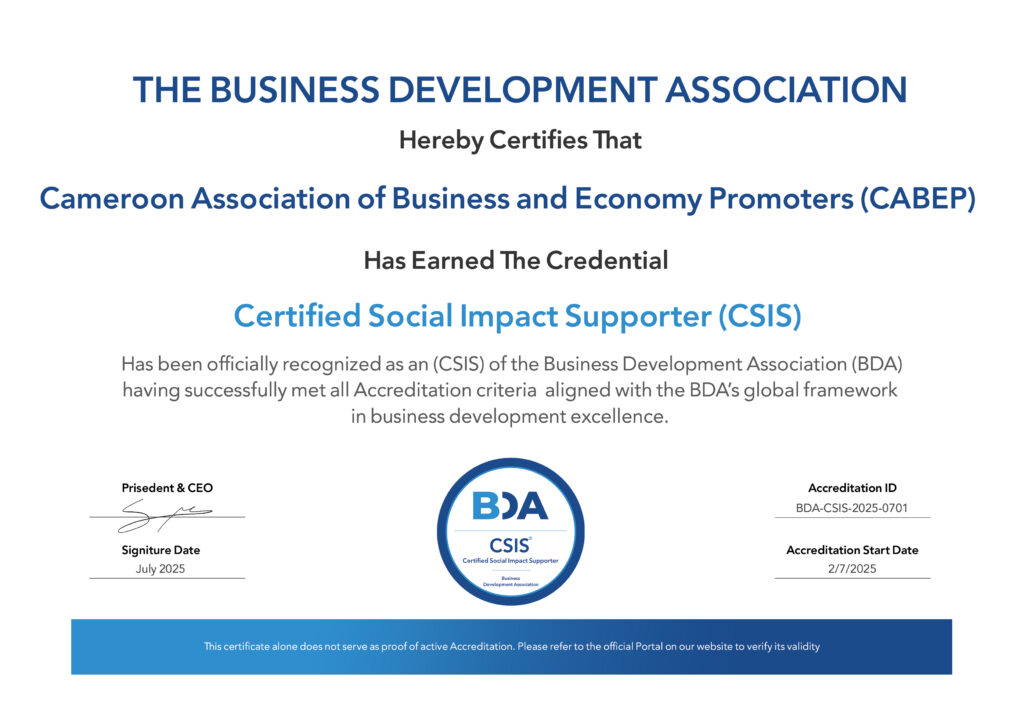
CABEP Becomes First Officially Accredited CSIS™ Entity in Africa

Accredited Organization: Cameroon Association of Business and Economy Promoters (CABEP)
Accreditation: CSIS™ – Certified Social Impact Supporter
Reference Code: BDA-CSIS-2025-0701


As part of its global mission to advance inclusive and sustainable business ecosystems, the Business Development Association (BDA) is proud to announce the official accreditation of CABEP – Cameroon Association of Business and Economy Promoters as a Certified Social Impact Supporter (CSIS™).

CABEP is the first entity in Africa to be awarded this recognition, marking a milestone in the continent’s engagement with BDA’s development standards.

About CABEP

Founded in 2024, CABEP is a Cameroon-based nonprofit organization committed to strengthening entrepreneurship and SME growth, particularly for youth, women, and underserved communities. Its core services include incubation, business advisory, training and capacity building, market access support, and innovation facilitation.

Notable initiatives include:

  • Start Small and Grow (SSG): An annual micro-business empowerment program targeting 100 disadvantaged women and youth with funding, training, and coaching.
  • 5X BGS (Business Growth Strategy): A regional entrepreneurship ecosystem initiative encouraging bold, scalable thinking with mentorship and collaboration.

Why CABEP Earned CSIS™ Accreditation

CABEP demonstrated outstanding commitment to sustainable and ethical impact by designing programs that empower marginalized groups, promote entrepreneurship, and align with the BDA Body of Competence & Knowledge (BoCK™) framework.

This accreditation is awarded to organizations that actively drive inclusive economic development and social impact through business support models that extend beyond profit into purpose.


About the CSIS™ Accreditation

The Certified Social Impact Supporter (CSIS™) is a specialized institutional accreditation granted to nonprofit organizations, public initiatives, and social-focused entities that lead and support community development through business enablement.

It recognizes efforts that advance:

  • Entrepreneurial equity
  • Social innovation
  • Community upliftment
  • Ethical business transformation

We congratulate CABEP on its achievement and welcome it into the BDA global impact network. This milestone reinforces our shared vision for empowering societies through inclusive business practices.

Learn more about BDA Accreditations: bda-global.org/accreditations

How to Become a Business Development Certified Professional (BDA-CP)

Business Development Certification is one of the most powerful ways to validate your strategic capabilities, expand your influence, and elevate your career in today’s competitive economy. Among the top-tier credentials in this domain stands the Business Development Certified Professional (BDA-CP) Certification, issued by the Business Development Association (BDA) — a globally recognized authority setting the standards for excellence in the field.

Whether you’re a business strategist, partnership lead, entrepreneur, or aspiring professional, this guide walks you through how to become a certified business developer through the BDA-CP certification pathway.


1. Understand What the BDA-CP Stands For

The BDA-CP™ (BDA Business Development Certified Professional) is designed for practitioners who wish to demonstrate their proficiency in strategic growth, market expansion, stakeholder engagement, and value creation.

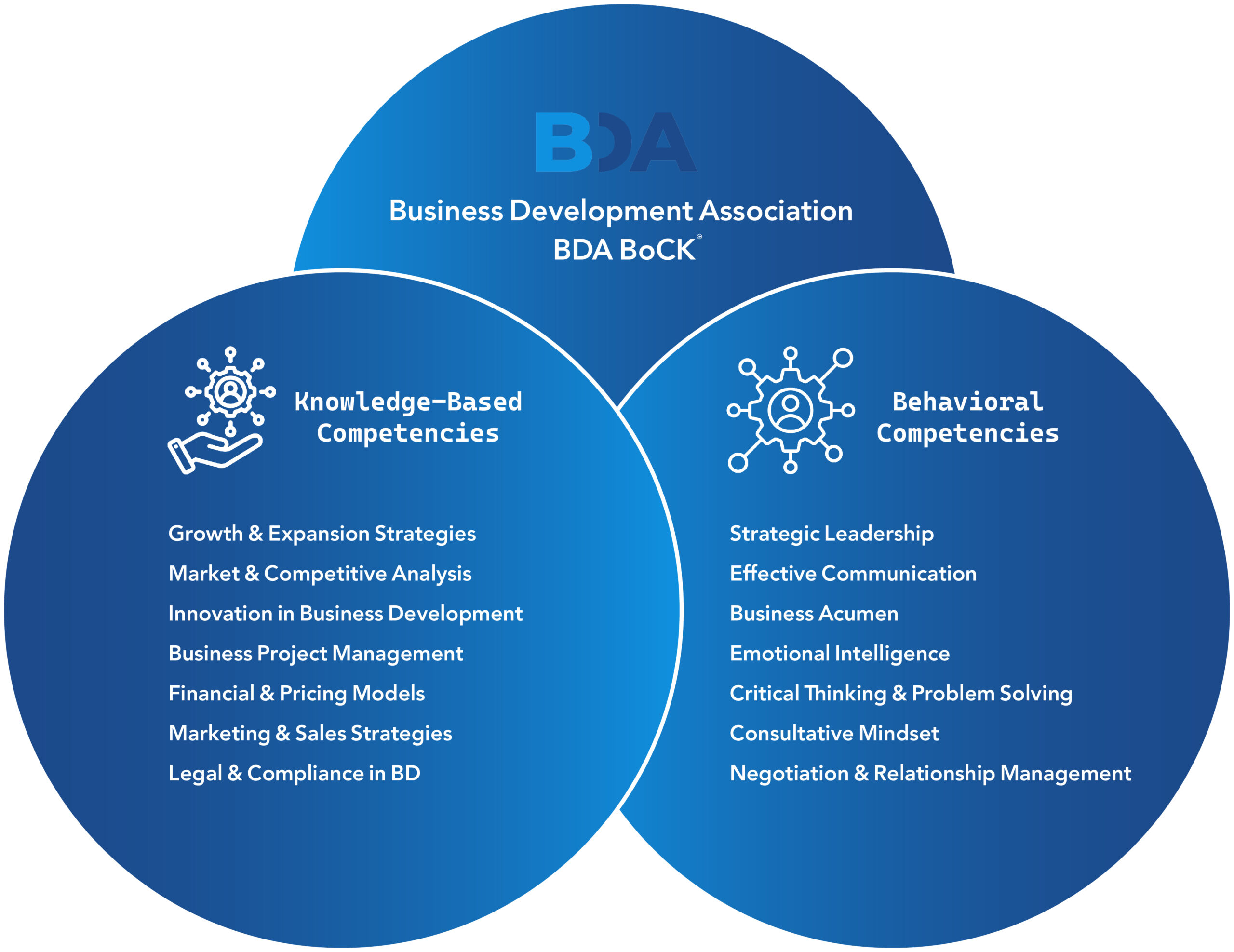
It is anchored in the BDA BoCK — the official Body of Competency & Knowledge — which outlines the required knowledge-based and behavioral skills across two pillars:

🔹 Knowledge-Based Competencies

  • Growth & Expansion Strategies
  • Market & Competitive Analysis
  • Innovation in Business Development
  • Project Management in BD
  • Financial & Pricing Models
  • Marketing & Sales Strategies
  • Legal & Compliance in BD

🔹 Behavioral Competencies

  • Strategic Leadership
  • Effective Communication
  • Emotional Intelligence
  • Business Acumen
  • Problem Solving
  • Consultative Mindset
  • Relationship Management

Learn more about the BoCK™ here


2. Meet the Eligibility Requirements

To apply for the Certified Business Development Professional (BDA-CP) Certification, you must demonstrate a foundation of academic and/or professional experience in business development or related fields. Typically, applicants fit one of the following profiles:

  • 3+ years in a business development or growth-related role
  • Bachelor’s degree in business, strategy, economics, or a related field
  • Experience in partnerships, sales strategy, product expansion, or client engagement

Even if you’re from adjacent fields (like consulting, investment, or project management), the BDA-CP helps formalize your role as a growth architect.


3. Study the BDA Curriculum & Prepare for the Assessment

The BDA provides a structured Business Development Certified Professional (BDA-CP) Learning Path, including:

  • The BDA-CP™ Guidebook – official overview of the certification
  • BoCK™ Manual – detailing every competency required
  • Assessment Sample Questions – practice scenarios and case-based tasks

You can download the Business Development Certified Professional (BDA-CP) Handbook here
Access the official BoCK™ here

Studying this material gives you a clear sense of what’s expected in the exam and prepares you to apply those competencies practically.


4. Submit Your Application

Applications for the Business Development Certified Professional (BDA-CP) are submitted directly via the BDA’s official website. The process includes:

  • Creating your member profile
  • Uploading supporting documents (CV, certificates)
  • Paying the certification fee
  • Selecting your preferred exam month

Start your application here: https://bda-global.org/bda-cp/


5. Take the Online Proctored Assessment

Once accepted, you’ll be scheduled to sit for the Business Development Certified Professional (BDA-CP) Exam — a scenario-based assessment testing your ability to apply strategic frameworks in business development contexts. The exam evaluates:

  • Real-world decision-making
  • Market analysis
  • Strategic recommendation
  • Ethical judgment

Duration: 180 minutes
Format: Online, case-based scenarios


6. Earn Your Business Development Certified Professional (BDA-CP) Credential & Leverage It

Upon passing, you receive:

  • Your Business Development Certified Professional (BDA-CP) Certificate
  • Access to the BDA Global Registry
  • Verified digital badge for LinkedIn and CV
  • Exclusive opportunities through BDA’s partner network

Holding the Business Development Certification from BDA positions you as a certified expert in growth and strategy, boosting your reputation, employability, and consulting credentials.


Conclusion

Becoming a Business Development Certified Professional (BDA-CP) is more than a credential it’s a transformation. The BDA-CP™ certification proves that you can think strategically, lead decisively, and generate value in complex business environments.

If you’re ready to elevate your business development career, start with the globally respected certification from BDA designed by professionals, for professionals.

Business Development Certification: Introducing the BDA-CP Program

"BDA BoCK competencies model showing knowledge and behavioral skills for business development professionals

What is BDA-CP?

BDA Certified Professional (BDA-CP) stands for Certified Business Development Professional, the flagship Business Development Certification for professionals looking to build a career in strategic growth, partnerships, and innovation.
It is issued by the Business Development Association (BDA) and grounded in the global BDA BoCK — a standardized competency model used to evaluate and upskill BD professionals worldwide.

Whether you’re entering the business development field or aiming to formalize your experience with a global credential, the Certified Business Development Professional (BDA-CP) equips you with the skills, language, and credibility to grow faster and lead smarter.


Why Choose BDA-CP as Your Business Development Certification?

  • Aligned with the BDA BoCK, covering both knowledge-based and behavioral competencies.
  • Globally applicable, with relevance across private, public, and nonprofit sectors.
  • Competency-based, focusing on applied knowledge—not just theoretical.
  • Professional recognition, including digital credentials and registry verification.
  • Career enhancer—use it to move into BD roles, lead partnerships, or manage strategic growth.

Looking for a reliable Business Development Certification with global credibility? BDA-CP is your benchmark.


BDA-CP Competency Framework (BDA BoCK)

The certification is based on the BDA BoCK™, which organizes competencies into two pillars:

1. Knowledge-Based Competencies

These are technical and strategic domains every certified business developer must master:

  • Growth & Expansion Strategies
  • Market & Competitive Analysis
  • Innovation in Business Development
  • Business Project Management
  • Financial & Pricing Models
  • Marketing & Sales Strategies
  • Legal & Compliance in BD

📌 These areas enable professionals to lead initiatives, pitch new solutions, and expand into new markets with clarity and control.

2. Behavioral Competencies

These reflect the mindset, leadership, and adaptability expected from modern BD professionals:

  • Strategic Leadership
  • Effective Communication
  • Business Acumen
  • Emotional Intelligence
  • Critical Thinking & Problem Solving
  • Consultative Mindset
  • Negotiation & Relationship Management

📌 Together, these soft skills ensure professionals can navigate ambiguity, influence stakeholders, and lead cross-sector partnerships.

BDA Body of Competency & Knowledge
BDA BoCK
BDA Body of Competency & Knowledge

Who Should Apply for the Certified Business Development Professional (BDA-CP)?

If you’re in—or transitioning into—any of the following roles, the Certified Business Development Professional (BDA-CP) Certification will amplify your profile:

  • Business Development Executives
  • Strategic Planners & Analysts
  • Partnership Managers
  • Innovation Leads
  • Management Consultants
  • Entrepreneurs
  • Government officers involved in transformation or growth

Certification Details

FeatureDetails
Certification NameCertified Business Development Professional (BDA-CP)
ProviderBusiness Development Association
Mode100% Online
LanguageEnglish & Arabic
Validity3 years (renewable via PDCs or re-exam)
Price€345

📘 Optional Add-ons:


Exam Format

  • Schedule: On-demand
  • Type: Online, timed, 100 MCQs
  • Duration: 180 minutes
  • Pass Mark: 75%
  • Proctoring: Secure browser + AI + optional human proctor

What You Receive

After passing, candidates receive:

  • Official BDA-CP Certificate (PDF + optional print)
  • Verified Digital Badge
  • Global Certification Registry Listing
  • Access to CPD Tools for ongoing renewal
  • Priority access to BDA Memberships

Benefits of Becoming a BDA-Certified Professional

  • Increase your visibility in strategic hiring pools
  • Transition smoothly from sales, consulting, or operations into BD
  • Work across public-private projects, government partnerships, NGOs
  • Gain a global title backed by a globally aligned knowledge system
  • Strengthen proposals, funding applications, and partnership negotiations

Want to Learn More?

Visit the BDA-CP Certification Page
Download the Certification Handbook
Read the BDA BoCK Overview


Conclusion

The Certified Business Development Professional (BDA-CP) is not just another certification it’s a global standard for what business development professionals should know, do, and lead. In a fast-changing economy where strategy, execution, and influence converge, this credential can be your strategic edge.

Ready to lead in Business Development?
Apply Now for Certified Business Development Professional (BDA-CP)

Key Business Development Skills: From Prospecting to Policy Influence

Infographic showing business development competencies including communication, innovation, stakeholder mapping, and policy impact

Introduction: Beyond Sales—BD as a Strategic Discipline

In this article, we unpack the core business development skills that define successful BD professionals, from entry-level contributors to senior transformation leaders. These skills align with the BDA BoCK™, the global competency framework used across certifications like Certified Business Development Professional (BDA-CP) and BDA Senior Certified Professional (BDA-SCP).

Business development is often reduced to a simple extension of sales. In reality, it is a far more complex and strategic function—one that requires an interdisciplinary skillset spanning market research, stakeholder influence, value design, and institutional transformation.

1. Prospecting and Opportunity Mapping

Effective BD begins with the ability to identify, qualify, and prioritize high-value opportunities. This requires more than just lead lists—it demands market intelligence, value alignment, and strategic foresight.

Professionals must master tools like Ideal Customer Profiles (ICP), scoring matrices, and ecosystem mapping to ensure they are targeting prospects with both need and strategic fit. Whether entering new markets or building institutional partnerships, structured prospecting is foundational.

🔗 Internal link: Business Development Frameworks

2. Consultative Communication and Influence

Modern BD requires professionals to operate as advisors—not just sellers. This means asking better questions, listening deeply, and shaping narratives that resonate with diverse stakeholders.

Whether it’s co-writing a policy proposal, negotiating a donor grant, or aligning corporate partners, BD success hinges on clarity, trust, and mutual value creation.

3. Strategic Relationship Management

Building lasting alliances demands more than good rapport—it involves mapping power structures, managing expectations, and delivering sustained value.

Tools like stakeholder maps and relationship dashboards help professionals design engagement strategies that evolve over time. From public officials to private investors, strategic relationship management is central to long-term BD success, and stands among the most critical business development skills today’s professionals must refine.

4. Financial and Strategic Evaluation

No BD initiative is sustainable without economic logic. Professionals must evaluate commercial viability, calculate ROI, and build investment cases that withstand scrutiny.

This skill becomes critical in business plans, funding proposals, and cross-sector negotiations—ensuring that BD efforts are not just creative, but credible.

5. Innovation and Co-Creation

The most transformative BD outcomes arise from innovation—not replication. Professionals must be equipped to co-design solutions, test them in the field, and iterate based on feedback.

Frameworks like the Innovation Canvas and MVP testing models help drive speed, learning, and differentiation.

6. Policy Influence and Institutional Navigation

In public and nonprofit settings, BD extends beyond markets—it involves navigating governance structures, advocating for reform, and aligning stakeholders behind shared outcomes.

BD professionals working with governments or donors must understand policy cycles, build alliances across ministries, and co-create frameworks for institutional change.

7. Execution and Adaptive Leadership

The best strategies fail without disciplined execution. BD leaders must mobilize teams, manage ambiguity, and adjust in real time.

Whether scaling a new partnership model or pivoting a market-entry strategy, adaptive leadership ensures that BD is not only designed—but delivered.

🔗 Internal link: BDA-SCP Leadership Capabilities

8. How BDA Certifications Build These Skills

The Certified Business Development Professional (BDA-CP) and BDA Senior Certified Professional (BDA-SCP) certifications are designed to codify and validate the skills described in this article.

  • BDA Certified Professional (BDA-CP) builds operational fluency across all foundational BD domains.
  • BDA Senior Certified Professional (BDA-SCP) equips leaders with strategic tools to drive change across sectors and geographies.

Both certifications are grounded in the BDA BoCK™, ensuring alignment with global standards. These programs directly reinforce core business development skills that drive institutional growth and cross-sector impact.

Conclusion: Build BD Skills with Precision

Business development is no longer optional—it is essential. In a global economy shaped by disruption and opportunity, the institutions that thrive will be those led by professionals with structured, validated, and globally relevant business development skills.

Whether you’re designing public-private alliances, leading policy innovation, or building new market entry playbooks, your BD capabilities are a strategic asset.

Begin your certification path with Certified Business Development Professional (BDA-CP) or BDA Senior Certified Professional (BDA-SCP) to accelerate your impact.

Download the BDA BoCK™ Guide for full skill frameworks and practical tools.

Business Development Models Types and When to Use Them

Visual representation of five strategic business development models including in-house, outsourced, academic, government-led, and donor-funded approaches

Why Business Development Models Matter

Business development (BD) has evolved from a loosely defined function to a core strategic discipline. Yet, many organizations still lack clarity on how to structure their BD efforts. Should it be led internally? Outsourced? Government-backed? Or driven through academic ecosystems? The answer depends on context, strategy, and capability.

This article explores the five most common business development models, their advantages and limitations, and how institutions can choose the right one. Each model aligns with the competencies outlined in the BDA BoCK™, and is supported by real-world use cases across sectors.

1. In-House Business Development Units

In this model, BD is managed as an internal department or team within the organization. It is common in large corporations, public institutions, and non-profits with strategic mandates.

Key Features:

  • Staffed with dedicated BD professionals
  • Aligned directly with executive leadership
  • Close to internal operations and stakeholders

Advantages:

  • Strong institutional alignment
  • Easier integration with strategic planning and data systems
  • Greater brand and message control

Challenges:

  • Risk of internal bias or bureaucratic stagnation
  • Slower market feedback

Best Used When:

  • The organization has scale, data access, and a long-term BD strategy
  • BD is linked to core transformation or innovation goals

🔗 Related Article suggestion: How to Build a Business Development Strategy

2. Outsourced or Agency-Led BD

This model involves partnering with an external firm to execute parts of the BD process—such as lead generation, channel access, or proposal development.

Common In:

  • Tech startups
  • Export firms
  • Regional expansion pilots

Advantages:

  • Speed and agility
  • Access to networks and talent not available internally
  • Reduced internal burden

Challenges:

  • Potential misalignment with brand or culture
  • Limited internal capability development

Best Used When:

  • The organization is scaling rapidly or entering new markets
  • Internal BD maturity is low

3. Academic or Incubator-Based BD

Many universities, research centers, and incubators now act as BD platforms for innovation-based enterprises. This model blends academia, entrepreneurship, and ecosystem development.

Features:

  • Access to youth talent, labs, and IP
  • Incubation, mentorship, and seed funding
  • Cross-sector collaboration (industry–academia)

Benefits:

  • Promotes innovation and experimentation
  • Fosters early-stage pipelines

Best Used When:

  • Operating in innovation clusters
  • Focus is on long-term value and capacity building

4. Government-Led or PPP Development Models

Public institutions increasingly build BD capacity to engage the private sector, attract investment, or stimulate job creation. These models work through government departments, public-private partnerships (PPP), or semi-governmental entities.

Characteristics:

  • Long-term national impact
  • High regulatory involvement
  • Multi-stakeholder alignment

Examples:

  • SME development agencies
  • Export authorities
  • Smart city or transformation programs

Challenges:

  • Bureaucratic complexity
  • Funding dependencies

Best Used When:

  • BD is tied to national or regional policy outcomes

5. Multi-Lateral or Development-Funded BD

This model involves BD initiatives funded or driven by international organizations such as UNDP, World Bank, GIZ, or USAID.

Contexts:

  • Fragile states
  • Development zones
  • Cross-border trade facilitation

Functions:

  • Economic empowerment
  • Entrepreneurship and MSME growth
  • Institutional reform

Challenges:

  • Coordination with multiple stakeholders
  • Short project cycles vs long-term goals

Best Used When:

  • Operating in low-resource or policy-constrained environments
  • Alignment with donor priorities

6. How to Choose the Right BD Model

Choosing the right BD model requires a structured assessment of:

  • Scope of Work: Internal vs External
  • Speed Required: Agile vs Strategic
  • Risk Appetite: Shared vs Owned
  • Resource Availability: In-house capacity vs External dependency
  • Strategic Alignment: Fit with organizational maturity and governance

A decision matrix or diagnostic tool can support this choice—available within the BDA BoCK™ toolkit.

7. Certification Alignment: Preparing for BD Models

BDA’s certifications prepare professionals for leadership across all five models:

  • BDA Certified Professional (BDA-CP): Equips individuals to operate and contribute within in-house and partner-led BD teams.
  • BDA Senior Certified Professional (BDA-SCP): Prepares senior professionals to architect and lead multi-sector BD models, including government and donor ecosystems.

🔗 Internal link suggestion: Business Development Certification Guide

Conclusion: No One-Size-Fits-All

Business development is a strategic function that must be aligned to context, resources, and ambition. Choosing the wrong model leads to fragmentation, inefficiency, and poor ROI.

At BDA, we help institutions and professionals navigate these options with clarity and precision—grounded in a global competency framework and applied in over 30 countries.

Ready to evaluate your own model? Start with the BDA BoCK™ or learn how to become a Certified Professional in BD.

Business Development Salaries by Role and Region

Infographic showing global business development salaries by region and role in 2025

Introduction

Business Development Salaries is no longer just a curiosity it’s a strategic imperative. Whether you’re entering the field or already leading regional BD efforts, your compensation is not merely tied to your title, but to a nuanced matrix of factors: demonstrated competencies, certification level, strategic influence, sector exposure, and geography.

Unlike commoditized roles with fixed bands, Business Development Salaries vary dramatically across functions, industries, and continents. Why? Because business development (BD) sits at the intersection of strategy, execution, and institutional growth. It’s not a support role—it’s a value multiplier.

This article goes beyond basic averages. It provides a comparative and competency-aligned perspective on compensation in business development, segmented by roles and regions. From BDRs in emerging markets to BD directors in multinational firms, we explore how skills, structure, and certification affect earnings and progression.

Whether you’re an aspiring BD professional looking to map your career or a decision-maker structuring your team’s rewards, this guide will help you understand the global BD compensation landscape—and how to rise within it.

Core Factors That Influence Business Development Salaries

While job titles often serve as a broad indicator of compensation, true variations in Business Development Salaries are driven by a more complex set of factors. Understanding these variables is essential for both professionals seeking growth and organizations aiming to retain top-tier talent.

1. Professional Experience and Role Seniority

Experience is the most visible salary driver—but not all experience is equal. A mid-level BD professional with ten years in a reactive, transactional sales environment may earn less than a younger professional who has delivered strategic partnerships or led cross-border expansion. The nature and impact of experience weigh more than tenure alone.

BD professionals with experience in policy influence, public-private collaboration, or institutional restructuring typically command higher salaries than those focused solely on client acquisition.

2. Certifications and Competency Recognition

Global certifications like Certified Business Development Professional (BDA-CP) & BDA Senior Certified Professional (BDA-SCP) particularly those aligned with structured frameworks like the BDA BoCK elevate earning potential significantly. They signal not just knowledge, but verified capability across strategy, execution, and transformation. Professionals holding BDA-CP or BDA-SCP certifications often enter a global talent pool, increasing their bargaining power.

Many hiring managers across Europe and the MENA region now view competency-aligned certifications as a prerequisite for senior BD roles.

3. Industry and Sector Specificity

Not all industries reward business development equally. High-margin, high-stakes sectors—such as technology, finance, consulting, and healthcare—tend to offer more competitive salaries. Government and nonprofit sectors may pay less but often compensate through influence, policy access, or long-term security.

For example, BD professionals in strategic consulting can earn 25–40% more than peers in the education sector at the same level.

4. Geographic Location

Regional economics, labor laws, and cost of living all play a role in shaping Business Development Salaries. Professionals in global financial hubs like Dubai, London, or Singapore often receive premium packages—yet competition and performance expectations are equally high.

In the GCC, bilingual BD managers with cross-sector experience and regional exposure are among the most sought-after and best-paid.

5. Strategic Value Delivered

Perhaps the most underestimated factor: measurable value created. Professionals who consistently contribute to market expansion, ecosystem design, or major partnership wins are often rewarded beyond the salary grid. Institutions increasingly use value-based KPIs to structure bonus models and leadership advancement.

It’s not about how many meetings you attend—it’s about how you de-risk growth and accelerate institutional transformation.

Salary by Role: Globally Benchmarked Roles

Understanding Business Development Salaries by role provides critical insight into how the field rewards capability, not just seniority. These benchmarks highlight how compensation evolves with complexity, responsibility, and institutional influence.

Business Development Representative (BDR)

Often seen as the entry point into the field, BDRs focus on lead qualification, market research, and initial outreach. While their base salaries are generally modest, top performers can access strong incentive-based pay depending on pipeline contribution and conversion rates.

  • Key Salary Influencers:
    • Commission structures
    • Geographic market
    • Integration with sales or growth teams
  • Common Range:
    • EUR 18,000–35,000 annually (varies widely by region)

BDRs who operate in strategic industries or contribute to high-value pipelines often out-earn peers in transactional sales roles.


Business Development Manager

BD Managers are the backbone of institutional expansion. They manage full lifecycle BD processes—strategic targeting, proposal design, stakeholder management, and partnership closure.

  • Key Salary Influencers:
    • Sector exposure (e.g., SaaS, consulting, education)
    • Project size and revenue responsibility
    • Presence of certification or structured training
  • Common Range:
    • EUR 40,000–80,000+ depending on region and organization size

Certified managers aligned with BDA BoCK™ competencies typically secure roles with higher base pay and faster progression to leadership.

Glassdoor – Global Business Development Manager Salary


Strategic Partnership Lead

This role sits at the intersection of diplomacy, strategy, and institutional transformation. Leads in this position are tasked with developing multi-stakeholder alliances, navigating policy environments, and securing long-term strategic value.

  • Key Salary Influencers:
    • Cross-sector experience
    • Policy and government engagement
    • Role in regional expansion strategies
  • Common Range:
    • EUR 70,000–120,000+

This is one of the fastest-growing subfields in BD, particularly in markets undergoing national transformation (e.g., GCC, ASEAN).


Director or VP of Business Development

At the top of the structure, BD directors or VPs shape institutional growth strategy. Their compensation reflects not just revenue goals but enterprise-wide impact, from innovation pipelines to global partnership portfolios.

  • Key Salary Influencers:
    • Strategic transformation experience
    • Global or regional oversight
    • Role in policy-level influence or M&A
  • Common Range:
    • EUR 100,000–200,000+ with performance bonuses and equity in some sectors

Organizations with mature BD functions increasingly tie executive compensation to long-term growth KPIs, not just annual revenue targets.

Glassdoor – Senior Global Business Development Manager Average Salary

Salaries by Region: Global Variations in Business Development Compensation

While job roles provide internal structure, geography shapes the external market value of those roles. Regional economic dynamics, institutional maturity, and talent supply all contribute to differences in Business Development Salaries. Here’s a comparative overview of key global markets:

Levels.fyi – LinkedIn BD Total Compensation


North America (United States & Canada)

North America remains the most mature and highest-paying BD market, especially in the tech, finance, and consulting sectors. Employers emphasize structured competencies and often reward strategic innovation over traditional deal-closing.

  • BDR Salary Range: EUR 30,000–45,000
  • Manager Level: EUR 60,000–110,000
  • Executive Level: EUR 130,000–200,000+

Professionals with cross-sector experience and certifications like BDA-CP/SCP are highly valued, especially in enterprise SaaS and advisory firms.


Europe (UK, Germany, France, Nordics)

Europe offers balanced compensation, with strong emphasis on strategic partnerships and public-sector engagement. Policy fluency and ESG integration often enhance value.

  • BDR Salary Range: EUR 25,000–40,000
  • Manager Level: EUR 55,000–90,000
  • Executive Level: EUR 100,000–170,000+

BD professionals fluent in cross-border collaboration and innovation funding often command premium roles.


GCC & MENA (UAE, KSA, Egypt, Qatar)

This region is witnessing explosive growth in strategic business development—driven by Vision 2030 agendas, FDI, and public-private transformation. Demand for certified, bilingual professionals is surging.

  • BDR Salary Range: EUR 18,000–32,000
  • Manager Level: EUR 40,000–85,000
  • Executive Level: EUR 90,000–160,000+

BD managers working across government, education, and consulting ecosystems can fast-track into strategic advisory roles.


Asia-Pacific (India, Singapore, Australia, Japan)

Compensation varies widely. Singapore and Australia lead in executive pay, while India offers strong career acceleration for skilled professionals in tech and consulting.

  • BDR Salary Range: EUR 15,000–30,000
  • Manager Level: EUR 35,000–70,000
  • Executive Level: EUR 80,000–150,000+

Regional fluency, sector specialization, and alignment with innovation agendas drive value here.


Africa & Latin America

Emerging economies offer strategic opportunities but more modest compensation. However, rapid infrastructure development and foreign investment create room for upward mobility and regional influence.

  • BDR Salary Range: EUR 12,000–22,000
  • Manager Level: EUR 25,000–50,000
  • Executive Level: EUR 60,000–90,000+

Professionals trained under international frameworks (like BDA BoCK™) often become national thought leaders or advisors.

Insights, Salary Trends & Final Recommendations

The global landscape of Business Development Salaries reveals more than just numbers—it reflects the strategic redefinition of what business development means in modern institutions. As BD transitions from an informal, sales-adjacent function into a core strategic engine, compensation models are evolving in parallel.

Emerging Trends in BD Compensation

  • Competency-Based Pay: Institutions are increasingly linking compensation to demonstrated competencies—particularly those outlined in structured frameworks like the BDA BoCK™.
  • Premiums for Cross-Sector Fluency: Professionals who can bridge government, private, and nonprofit sectors often access higher-value roles and strategic advisory opportunities.
  • Hybrid Role Compensation: BD is merging with innovation, sustainability, and transformation—creating high-paying hybrid roles that require interdisciplinary skillsets.

Recommendations for BD Professionals

  1. Invest in Certification and Knowledge
    Credentials such as BDA-CP and BDA-SCP not only validate skills but also command higher salaries across regions. They signal a strategic mindset, not just execution capacity.
  2. Build a Global Profile
    Leverage cross-border projects, regional networks, and digital tools to position yourself as a global growth architect.
  3. Negotiate Beyond Titles
    Tie compensation conversations to your strategic contribution—market expansion, revenue unlocked, partnerships built—not just job descriptions.

For Employers & HR Leaders

  • Design BD roles aligned with long-term transformation goals.
  • Integrate structured frameworks like BDA BoCK™ into performance reviews and salary bands.
  • Develop leadership pipelines that include BD as a distinct track alongside operations, marketing, and finance.

Conclusion: Reframing Value in Business Development

The future of business development is not transactional—it is transformational. And as BD professionals evolve into architects of growth, their compensation should reflect that evolution. Understanding Business Development Salaries through the lens of strategy, geography, and structured capability offers more than transparency—it offers a roadmap.

For professionals, it’s a call to level up. For organizations, it’s a guide to retain and reward the minds driving their future.

How to Make a Business Development Plan

Illustration of a structured business development plan with strategic steps

1. Introduction: What Is a Business Development Plan and Why It Matters

A business development plan is not just a document—it is the blueprint for how an organization will grow, scale, and sustain its strategic ambitions. Whether you’re a startup founder aiming to enter new markets, or an executive shaping institutional growth, having a structured business development plan ensures clarity, direction, and measurable impact.

Unlike traditional business plans, a business development plan focuses exclusively on how value will be created, where growth will originate, and which partnerships, tools, and strategies will drive competitive advantage. It aligns organizational goals with opportunities in the market—and provides the roadmap to act on them.

In this guide, we walk through every component of building an effective business development plan from defining your opportunity landscape, to setting KPIs and deploying stakeholder strategies. Grounded in BDA’s global standards and the BDA BoCK, this article offers a step-by-step approach for creating a plan that’s not only strategic, but operationally sound.

Let’s start by understanding what makes a strong business development plan and how you can build one that actually delivers results.


2. Foundational Elements of a Strong Business Development Plan

To develop a high-impact business development plan, it’s critical to start with foundational alignment. This section outlines the structural and strategic pillars that differentiate a tactical document from a transformative roadmap.

A. Alignment with Organizational Strategy

A business development plan must not exist in isolation, it must align with the broader strategic direction of the organization. Ask:

  • What are the organization’s top three strategic goals over the next 1–3 years?
  • How will business development activities contribute to achieving them?
  • What new markets, segments, or alliances support these ambitions?

This alignment ensures that business development doesn’t drift into reactive deal-hunting but remains anchored in value creation.


B. Integration with the BDA BoCK™ Competencies

The Business Development Association’s Body of Competency and Knowledge (BDA BoCK) outlines 14 global competencies across behavior, knowledge, and execution. Every effective business development plan should reflect these capabilities. For example:

  • Strategic Thinking and Leadership helps guide decision-making under uncertainty.
  • Growth Strategy Formulation supports scenario-based opportunity analysis.
  • Institutional Transformation ensures readiness for execution and scale.

C. Clarity of Value Proposition and Business Model

Before mapping out tactics, the plan must define:

  • What unique value are we creating?
  • Who is our intended beneficiary (client, government, partner, sector)?
  • How will we generate and sustain revenue from this value?

Articulating a clear business model—from customer archetypes to pricing logic—provides the foundation for targeting, messaging, and prioritizing.


D. Ecosystem and Policy Considerations

In today’s interconnected economy, no business development plan can be complete without understanding:

  • Regulatory environments and policy incentives
  • Stakeholder influence maps (government, funders, platforms)
  • Ecosystem readiness for collaboration (e.g., cluster maturity, tech adoption)

These considerations prevent misalignment and wasted effort in non-viable directions.


E. Strategic Resource Mapping

Lastly, define the assets you can deploy:

  • Talent (internal or via partnerships)
  • Data and market intelligence
  • Tools (CRM, innovation platforms, financial models)

This helps build a realistic, resourced plan—not just a wishlist of ideas.


3. Step-by-Step Framework for Building a Business Development Plan

Creating a high-performing business development plan requires a structured, repeatable framework. Below is a step-by-step process that aligns with global best practices and the BDA BoCK, making the plan both strategic and operational.


Step 1: Define Growth Objectives

Start by clearly articulating what the organization aims to achieve through business development:

  • Enter new markets or sectors
  • Diversify offerings or revenue streams
  • Build strategic partnerships or alliances
  • Influence public-private collaboration

These objectives must be SMART: Specific, Measurable, Achievable, Relevant, and Time-bound.


Step 2: Conduct Opportunity Landscape Analysis

Use structured tools such as:

  • PESTEL (Political, Economic, Social, Technological, Environmental, Legal) for macro-environment scanning
  • Porter’s Five Forces for industry competitiveness
  • Market Attractiveness vs. Strategic Fit Matrix to prioritize targets

The goal is to identify high-impact, viable opportunities that align with your capabilities and strategic positioning.

External Link Suggestion: Harvard Business Review on Market Analysis


Step 3: Map Stakeholders and Partners

Success in business development is stakeholder-driven. This step involves:

  • Identifying influencers, decision-makers, and blockers
  • Mapping strategic alliances (cross-sector, regional, institutional)
  • Assessing partner value alignment, resource complementarity, and risk appetite

Use stakeholder mapping templates or BD-specific CRM systems to track engagement.

Check “Strategic Partnerships” article on BDA Knowledge Center


Step 4: Design Engagement and Activation Strategies

For each opportunity or segment:

  • Define your Go-to-Engagement Strategy: Direct approach, intermediaries, consortiums, etc.
  • Plan your activation activities: Workshops, proposals, pilot projects, co-design sessions.
  • Tailor your messaging to the audience’s pain points, KPIs, and language.

This ensures relevance and resonance.


Step 5: Define Metrics and Performance Monitoring

Establish success indicators beyond just “deals closed,” such as:

  • Opportunity pipeline velocity
  • Partnership conversion rate
  • Strategic alignment score
  • Stakeholder influence rating

Use dashboards and regular reviews to measure progress, adjust tactics, and escalate what works.


Step 6: Governance and Review Loops

Business development plans require ongoing calibration. Include:

  • Monthly or quarterly review cycles
  • Executive sponsorship and escalation channels
  • Structured decision-making governance (steering committees, checkpoints)

This ensures accountability and agility in execution.


4. Common Mistakes in Business Development Planning and How to Avoid Them

Even the most ambitious business development plan can fail if common strategic pitfalls are not avoided. Below are the top errors organizations make when planning their BD efforts, and how to safeguard your strategy.


Mistake 1: Confusing Business Development with Sales Execution

Issue: Many organizations reduce BD to lead generation or closing deals activities more aligned with sales.

Why It’s Harmful: This narrow lens neglects the long-term strategic goals of ecosystem building, market shaping, and value innovation.

How to Avoid It:

  • Anchor your plan in the BDA BoCK competencies.
  • Keep BD embedded within the strategy or transformation function—not just sales.

Read: What Business Development Is Not


Mistake 2: Starting with Tactics, Not Strategy

Issue: Some teams jump straight to activities—partnership meetings, events, campaigns—without strategic clarity.

Why It’s Harmful: Tactics without strategic anchoring often lead to fragmented efforts and wasted resources.

How to Avoid It:

  • Begin with value propositions, positioning, and priority targets.
  • Map everything back to growth objectives and strategic alignment.

Mistake 3: Treating It as a Static Plan

Issue: Organizations often view the plan as a one-time deliverable.

Why It’s Harmful: Market dynamics shift constantly. Static plans become obsolete quickly.

How to Avoid It:

  • Build in review loops, feedback channels, and scenario planning.
  • Update the plan quarterly based on results, intel, and feedback.

Mistake 4: Ignoring Ecosystem and Policy Factors

Issue: Internal-focused plans often overlook external dependencies like regulation, funding, or alliances.

Why It’s Harmful: Missed risks, delayed execution, or misaligned offers.

How to Avoid It:

  • Conduct a full stakeholder and ecosystem analysis.
  • Track regulatory and economic developments closely.

OECD Policy Trends on Business Ecosystems


Mistake 5: Underinvesting in Capability and Governance

Issue: Many plans assume execution will happen without investing in people, tools, or governance structures.

Why It’s Harmful: Leads to plan fatigue, slow delivery, and internal misalignment.

How to Avoid It:

  • Allocate resources for capability building (training, systems, analytics).
  • Appoint clear owners and escalation mechanisms.

5. Tools and Technologies to Support Your Business Development Plan

A well-structured business development plan is only as effective as the tools that enable its execution, measurement, and optimization. Leveraging the right technologies not only increases productivity—it ensures your BD efforts are aligned, data-driven, and scalable.


A. Strategic Planning & Intelligence Tools

Purpose: For environmental scanning, opportunity identification, and market analysis.

Recommended Tools:

  • Statista / IBISWorld: Market research databases to support sector intelligence.
  • Crunchbase / PitchBook: For deal sourcing, investor intel, and partnership mapping.
  • PESTEL & SWOT Templates: Frameworks to analyze macro trends and institutional readiness.

Using Business Development Frameworks for Competitive Advantage


B. Relationship Management & CRM Platforms

Purpose: To manage pipeline, stakeholder engagement, and relationship capital.

Recommended Tools:

  • HubSpot CRM / Salesforce: Track leads, deals, and communication.
  • Nimble / Zoho CRM: More lightweight options for smaller teams.

BD-Specific Tips:

  • Create BD-specific deal stages (e.g., exploratory > aligned > MoU > value co-design).
  • Integrate relationship health scoring with engagement metrics.

C. Project Management & Execution Platforms

Purpose: Align internal teams on BD execution—especially in multi-stakeholder initiatives.

Recommended Tools:

  • Notion / Trello / Asana: Visual task boards and timelines.
  • Miro / Lucidchart: Strategic planning, mapping, and workshop design.

D. Communication & Visibility Tools

Purpose: Ensure external partners, internal teams, and leadership are all aligned.

Recommended Tools:

  • Loom / Zoom: For asynchronous and synchronous communication.
  • Canva / Figma: For BD pitch decks and co-branded proposals.
  • Google Data Studio / Tableau: To visualize BD metrics and dashboards.

E. Integration with KPIs and BD Analytics

Purpose: To track and optimize business development efforts continuously.

Key Metrics to Track:

  • Time-to-value for new partnerships
  • Pipeline velocity and close ratio
  • Strategic alignment scores
  • Ecosystem expansion metrics

Note: Ensure that all tools integrate into a single BD dashboard or ecosystem to avoid fragmentation.


6. How to Present and Operationalize Your Business Development Plan

Building a great business development plan is only half the battle—presenting it effectively and ensuring it becomes a living, operational framework is where real impact begins. Below is a strategic guide to moving from plan to execution across internal and external stakeholders.


A. Structuring the Presentation for Executive Buy-in

Executives don’t just want to see goals—they want confidence in direction, credibility in execution, and clarity on ROI.

Key Sections in the Presentation:

  • Vision & Strategic Fit: Link the BD plan to the organization’s overall mission and growth pillars.
  • Opportunity Landscape: Use data to highlight market gaps, trends, and timing.
  • Capability Mapping: Show internal readiness across competencies (aligned with the BDA BoCK™).
  • Partnerships & Alliances: Identify who you need to collaborate with—and why.
  • Execution Roadmap: Milestones, timelines, metrics, and ownership.

Business Development Skills Every Professional Needs


B. Cross-Functional Alignment

No BD plan can succeed in isolation. It needs full alignment with:

  • Marketing: To support campaigns, messaging, and lead generation.
  • Sales: To convert opportunities into revenue within defined playbooks.
  • Operations: To deliver value and scale services/products post-activation.
  • Legal/Compliance: Especially in regulated sectors or government partnerships.

Tip: Host an internal “BD Activation Workshop” to align all departments before launch.


C. Embedding the Plan in Daily Operations

Your BD plan should not sit in a drawer—it should be visible, operational, and actionable.

How to Embed It:

  • Weekly BD Stand-Ups: To review progress, obstacles, and strategic priorities.
  • KPI Dashboards: Shared and updated metrics (deal flow, partnerships, etc.)
  • Linked Competency Pathways: Ensure team training is linked to BD plan areas (e.g. strategy, partnerships, transformation).

Cultural Note: Treat BD as an intelligence function—not just a commercial one. Its success is tied to how well it guides decision-making across the organization.


7. Conclusion + Downloadable Business Development Plan Template

A strong business development plan is not a document—it’s a strategic engine. It aligns your institution’s goals with market opportunity, operational capacity, and long-term positioning. Whether you’re a startup entering new markets or a government body seeking transformative partnerships, the success of your BD efforts hinges on structure, clarity, and execution.

By following the structured steps outlined in this guide—from situation analysis and goal-setting to tool adoption and cross-functional activation—you position your team for sustainable, scalable growth.

Key Takeaways:

  • Treat business development as a strategy discipline, not a sales extension.
  • Anchor your plan in the BDA BoCK competencies to ensure global alignment.
  • Use integrated tools and dashboards to make BD measurable and accountable.
  • Empower teams to operate within a clear, agile framework that encourages innovation and partnership.

🔗 Suggested Internal Links: