Business Development Certifications: Complete Guide to BDA-CP & BDA-SCP

Business development has evolved into a strategic discipline that extends far beyond traditional sales activities.
Modern organisations increasingly depend on professionals capable of:
- driving sustainable growth
- analysing markets strategically
- managing complex partnerships
- leading expansion initiatives
- navigating competitive disruption
- aligning growth with long-term organisational objectives
As business development becomes more specialised and competency-driven, professional certifications are also becoming increasingly important for validating capability, strengthening credibility, and supporting career progression.
The Business Development Association (BDA®) developed the:
to establish globally aligned standards for business development competence based on the BDA Body of Competency & Knowledge (BDA BoCK®) framework.
This guide provides a comprehensive overview of:
- the certifications
- competency structure
- examination process
- preparation methods
- eligibility pathways
- assessment philosophy
- recertification requirements
- strategic career value
What Is Business Development?
Before understanding the certifications themselves, it is important to understand how BDA defines business development as a professional discipline.
According to BDA’s definition of business development, business development is a strategic function focused on identifying, creating, and expanding long-term value through:
- market growth
- partnerships
- innovation
- strategic relationships
- expansion opportunities
- organisational capability development
This perspective positions business development as an integrated strategic discipline rather than simply a sales extension.
The BDA certification framework was developed to validate competence within this broader professional context.
What Are BDA-CP® and BDA-SCP®?
BDA-CP® and BDA-SCP® are professional business development certifications designed for professionals operating at different levels of strategic complexity.
Both certifications are based on the same:
- BDA BoCK® framework
- competency architecture
- weighting structure
- professional standards
The primary difference between the two certifications lies in:
- assessment complexity
- scenario difficulty
- strategic depth
- expected professional maturity
This distinction is frequently misunderstood in the market.
BDA-CP® and BDA-SCP® do not assess different competencies.
Both certifications evaluate the same 14 competencies defined within the BDA BoCK® framework.
Understanding the Difference Between BDA-CP® and BDA-SCP®
BDA-CP® (BDA Certified Professional)
The BDA-CP® certification is designed for professionals seeking to validate operational and strategic business development capability within real-world environments.
It is commonly pursued by:
- business development executives
- account managers
- partnership specialists
- growth professionals
- sales and commercial professionals transitioning into strategic BD roles
- consultants and client-facing professionals
The certification focuses on competency application across foundational and intermediate business development scenarios.
BDA-SCP® (BDA Senior Certified Professional)
The BDA-SCP® certification is designed for professionals operating in more advanced strategic environments.
It is commonly pursued by:
- senior business development managers
- strategic growth leaders
- directors and department heads
- consultants
- transformation leaders
- professionals managing expansion initiatives and complex stakeholder ecosystems
The certification evaluates the same competencies as BDA-CP®, but through significantly more advanced and scenario-driven strategic situations.
The emphasis shifts toward:
- strategic judgement
- leadership complexity
- organisational decision-making
- market ambiguity
- executive-level business development capability
The BDA BoCK® Framework: The Foundation of Both Certifications
The BDA BoCK® framework serves as the foundational competency architecture for all BDA certifications.
The framework was developed to establish globally aligned standards for business development capability across industries and organisational environments.
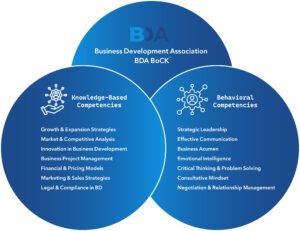
The BDA BoCK® defines 14 core competencies divided into two categories:
Behavioural Competencies
The behavioural competencies focus on leadership, communication, judgement, and relationship capability.
These competencies include:
- Strategic Leadership
- Effective Communication
- Business Acumen
- Emotional Intelligence
- Critical Thinking & Problem Solving
- Consultative Mindset
- Negotiation & Relationship Management
Knowledge-Based Competencies
The knowledge-based competencies focus on strategic and technical business development disciplines.
These competencies include:
- Growth & Expansion Strategies
- Market & Competitive Analysis
- Innovation in Business Development
- Business Project Management
- Financial & Pricing Models
- Marketing & Sales Strategies
- Legal & Compliance in Business Development
Together, these competencies establish a structured model for modern business development capability.
Examination Structure and Content
Both BDA-CP® and BDA-SCP® examinations are structured around competency-based assessment principles.
The exams are designed to evaluate not only theoretical understanding, but also the ability to apply competencies in practical business development contexts.
According to the official BDA examination structure:
- Total Questions: 120 multiple-choice questions
- Duration: 3 hours
- Delivery Method: Online proctored examination
- Passing Score: 70%
- Assessment Style:
- BDA-CP® → operational and intermediate complexity
- BDA-SCP® → advanced strategic and scenario-driven complexity
Competency Weighting and Examination Distribution
The competency distribution is aligned across both certifications.
The exam content structure includes:
Core Competencies
Higher-weighted competencies:
- Strategic Leadership
- Growth & Expansion Strategies
- Market & Competitive Analysis
- Negotiation & Relationship Management
Important Competencies
Medium-weighted competencies:
- Effective Communication
- Emotional Intelligence
- Critical Thinking & Problem Solving
- Consultative Mindset
- Innovation in Business Development
- Business Project Management
Supporting Competencies
Supporting strategic competencies:
- Business Acumen
- Financial & Pricing Models
- Marketing & Sales Strategies
- Legal & Compliance in Business Development
Download the Official Examination Content Outline
How to Prepare for BDA Certifications
Successful preparation requires more than memorisation.
Because the certifications are competency-based, candidates are expected to:
- interpret scenarios
- apply strategic judgement
- evaluate market conditions
- analyse relationships between competencies
- make informed business development decisions
The recommended preparation process typically includes:
1. Study the BDA BoCK®
The BDA BoCK® is the primary preparation reference for both certifications.
Candidates should focus on:
- competency interpretation
- framework application
- strategic concepts
- practical business development tools
- scenario understanding
2. Review Competency Areas Systematically
Candidates should study all 14 competencies comprehensively rather than focusing on isolated topics.
3. Practice Scenario-Based Questions
One of the most important preparation methods is practising applied and scenario-driven questions.
4. Evaluate Your Readiness
Candidates can evaluate their current capability level through the:
BDA Competency Assessment Tool
The assessment evaluates all 14 BDA BoCK® competencies and helps candidates determine whether they are:
- ready for BDA-CP®
- prepared for BDA-SCP®
- still building foundational competency maturity
Which Certification Is Right for You?
Choosing between BDA-CP® and BDA-SCP® depends less on job title and more on:
- strategic complexity exposure
- leadership responsibility
- business development maturity
- market decision-making experience
BDA provides an official pathway guide to help candidates evaluate the appropriate certification level.
Which Certification Is Best for Me?
How the Certification Process Works
The certification process generally includes:
- Selecting the appropriate certification pathway
- Reviewing eligibility guidance
- Registering for the examination
- Preparing using BDA resources
- Completing the online examination
- Receiving certification status upon passing
- Maintaining certification through recertification requirements
Recertification and Continuing Professional Development
Business development continues evolving rapidly due to:
- AI transformation
- market disruption
- global competition
- digital acceleration
- evolving customer behaviour
As a result, professional capability must also remain current.
BDA certifications therefore include recertification requirements designed to support ongoing professional development and competency maintenance.
Recertification may involve:
- continuing professional education
- approved development activities
- industry contribution
- competency renewal requirements
This ensures certified professionals remain aligned with evolving business development practices and strategic standards.
How BDA Certifications Compare to Other Business Development Certifications
Many professionals researching certifications compare:
- competency depth
- strategic relevance
- assessment quality
- market recognition
- practical applicability
Unlike certifications focused narrowly on sales activity or theoretical coursework, BDA certifications are structured around:
- competency validation
- applied capability
- strategic business development practice
- real-world decision-making
Business Development Certification Comparison
Why Competency-Based Certification Matters
Modern organisations increasingly require professionals who can demonstrate applied strategic capability rather than theoretical familiarity alone.
Competency-based certification helps organisations:
- evaluate professional capability more consistently
- strengthen strategic alignment
- support growth governance
- improve leadership readiness
- standardise business development expectations
For professionals, competency-based certification supports:
- career credibility
- structured capability development
- strategic growth opportunities
- international professional recognition
The Strategic Importance of Business Development Standards
Business development has historically lacked globally standardised competency structures compared to other professional disciplines.
The BDA framework addresses this challenge by establishing:
- competency architecture
- professional standards
- certification governance
- structured capability development pathways
This broader standards-oriented approach is one of the reasons why BDA certifications are increasingly referenced within discussions surrounding:
- strategic growth
- partnership management
- business expansion
- competency-based leadership
- AI-enabled business development
Conclusion
BDA-CP® and BDA-SCP® represent more than professional credentials.
They are competency-based certifications built to validate strategic business development capability within increasingly complex global business environments.
Both certifications are grounded in the same BDA BoCK® framework and competency structure, with differences focused primarily on strategic complexity and assessment depth.
For professionals seeking to strengthen:
- strategic leadership
- market analysis capability
- growth planning
- partnership management
- innovation capability
- business development credibility
the BDA certification pathway provides a structured and globally aligned professional development framework.
Whether pursuing foundational strategic capability through BDA-CP® or advanced leadership validation through BDA-SCP®, the certifications are designed to support long-term professional growth in modern business development environments.