There are no products in the cart.

The Institutional Value of Aligning with Global Business Development Standards
Partnership with the Business Development Association (BDA) represents a strategic institutional decision rather than a transactional collaboration.
As the global authority defining professional standards in business development, BDA partnerships are designed to support the long-term credibility, relevance, and governance of institutions operating within the business development ecosystem. The value of partnership lies not in short-term advantages, but in sustained alignment with globally recognized competencies, knowledge frameworks, and professional integrity.
BDA partnership benefits are therefore institutional in nature, reflecting what organizations become part of not merely what they receive.
One of the most significant benefits of partnering with BDA is the acquisition of global professional legitimacy.
Institutional credibility in today’s professional landscape is no longer determined solely by market presence or promotional visibility. It is increasingly defined by alignment with recognized standards that transcend local markets and commercial claims. Through partnership with BDA, institutions position themselves within a globally governed framework that defines how business development competence is understood, applied, and maintained.
This legitimacy is cumulative and enduring. It reflects adherence to structured standards, governance principles, and ethical expectations that signal trustworthiness to professionals, employers, academic bodies, and policy stakeholders worldwide.
Join a movement that’s shaping the future of business development.
Still not sure?
Talk to our support team We'll help you choose what's best.
The association has developed a comprehensive framework of competencies and knowledge. BDA BoCK® To be a global reference for best practices. It includes:
This framework is the cornerstone of all the association's business development certifications and accreditations.
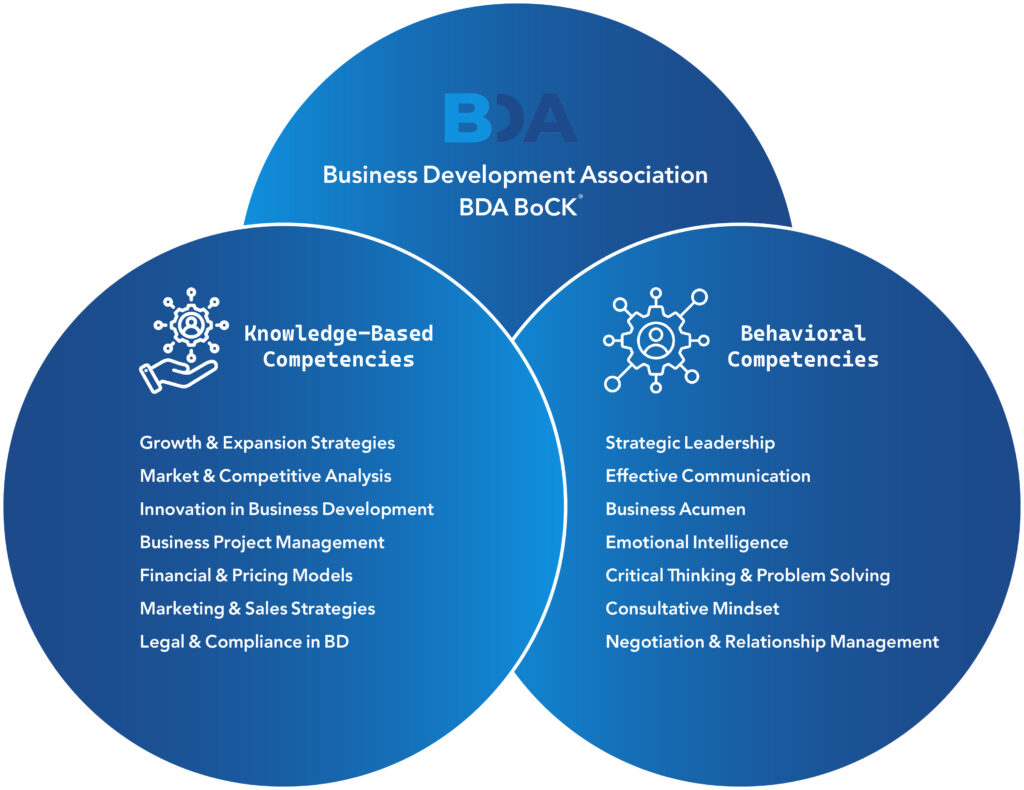
BDA partnerships provide access to a structured professional ecosystem governed by defined roles, responsibilities, and quality assurance mechanisms.
Unlike informal networks or commercial alliances, the BDA ecosystem is built around governance rather than convenience. Partners operate within clearly articulated frameworks that distinguish between certification integrity, continuing professional development, academic alignment, and strategic collaboration.
This ecosystem approach enables scalability without sacrificing consistency, allowing institutions to contribute locally while remaining aligned with global professional standards. Participation signals commitment to professional order, clarity of role, and long-term ecosystem development.

BDA partners are not passive recipients of recognition.
They actively contribute to:
The evolution of business development competencies
The refinement of professional knowledge frameworks
The dissemination of best practices across regions and industries
This contribution positions partners as stakeholders in the profession’s future, not just service providers.

Unlike transactional partnerships, BDA partnerships are designed for long-term institutional relevance.
Partners gain:
Sustainable positioning aligned with professional standards
Reduced dependence on short-term market trends
Strategic resilience through alignment with a global authority
This long-term orientation distinguishes BDA partnerships from purely commercial affiliations.

Depending on partnership model, BDA partners may gain structured access to:
Competency and knowledge frameworks
Professional development recognition pathways
Certification-aligned standards and policies
Academic and research alignment mechanisms
Access is governed, reviewed, and aligned with defined institutional roles to ensure integrity and consistency.
The ECP™ model represents the highest level of institutional alignment with BDA certification standards.
ECPs support the validation, endorsement, and quality assurance of certification-related programs, ensuring alignment with global competency and assessment requirements.
The PDP™ model enables organizations to deliver professional development programs that are formally reviewed and recognized within the BDA continuing development framework.
PDPs play a critical role in maintaining professional competence and lifelong learning aligned with BDA standards.
The AKP™ model establishes collaboration with academic institutions seeking to align curricula, courses, and research with globally accepted business development knowledge standards.
AKPs contribute to the academic validation and evolution of the business development discipline.
The SAP™ model represents strategic cooperation with sovereign entities, ministries, chambers of commerce, and professional bodies that shape national and regional business development ecosystems.
SAPs support policy alignment, national capacity building, and large-scale professional adoption of business development standards.